

AXI System ID
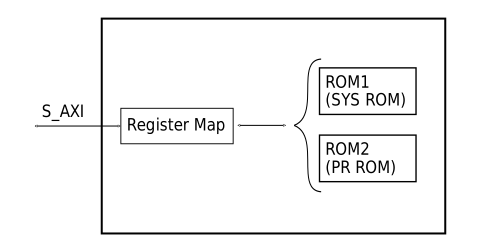
The System ID solution is comprised of 2 IP cores: the AXI System ID which provides the AXI Lite interface and System ID ROM which acts as a ROM and contains the data. Together, they provide the user with information regarding the conditions in which the hardware system was built. The System ID information is used to provide information about the system’s bit file, to facilitate future debugging actions. This information will be stored internally in a ROM and will be made available to the system via the AXI Lite interface.
Files
Name |
Description |
|---|---|
Verilog source for the peripheral. |
Block Diagram
Configuration Parameters
AXI System ID
Name |
Description |
|---|---|
ROM_WIDTH |
ROM width. |
ROM_ADDR_BITS |
Number of address bits. |
System ID ROM
Name |
Description |
|---|---|
ROM_WIDTH |
ROM width. |
ROM_ADDR_BITS |
Number of address bits. |
PATH_TO_FILE |
Location of ROM init file. |
Interface
AXI System ID
Name |
Description |
|---|---|
sys_rom_data |
Data input from System ROM. |
pr_rom_data |
Data input from PR ROM. |
rom_addr |
ROM address output. |
s_axi |
AXI Slave Memory Map interface. |
System ID ROM
Name |
Description |
|---|---|
clk |
Input clock. |
rom_addr |
Address input. |
rom_data |
Data output. |
Clocking
The IP core runs on the AXI clock and requires a frequency of 100MHz.
Register Map
Address |
Reg Name |
|||||
|---|---|---|---|---|---|---|
HDL |
DWORD |
BITS |
Field Name |
Type |
Default Value |
Description |
0x0 |
0x0 |
VERSION |
Version of the peripheral. Follows semantic versioning. Current version 1.1.61. |
|||
[31:16] |
VERSION_MAJOR |
RO |
0x0001 |
|||
[15:8] |
VERSION_MINOR |
RO |
0x00 |
|||
[7:0] |
VERSION_PATCH |
RO |
0x61 |
|||
0x1 |
0x4 |
PERIPHERAL_ID |
||||
[31:0] |
PERIPHERAL_ID |
RO |
ID |
Value of the ID configuration parameter. |
||
0x2 |
0x8 |
SCRATCH |
||||
[31:0] |
SCRATCH |
RW |
0x00000000 |
Scratch register useful for debug. |
||
0x3 |
0xc |
IDENTIFICATION |
||||
[31:0] |
IDENTIFICATION |
RO |
0x53594944 |
Peripheral identification (‘S’, ‘Y’, ‘I’, ‘D’). |
||
0x200 |
0x800 |
SYSROM_START |
||||
[31:0] |
SYSROM_START |
RO |
Start of register space for System ROM. Initialized at synthesis. |
|||
0x400 |
0x1000 |
PRROM_START |
||||
[31:0] |
SYSROM_START |
RO |
Start of register space for partial reconfiguration block ROM. Initialized at synthesis. |
|||
Access Type |
Name |
Description |
|---|---|---|
RO |
Read-only |
Reads will return the current register value. Writes have no effect. |
RW |
Read-write |
Reads will return the current register value. Writes will change the current register value. |
Theory of Operation
The System ID consists of a system of 2 or more IP cores where one provides access to the AXI Lite interface, and the other behaves as a ROM. There can be more than one ROM IP cores if required. The information contained by the ROM will be generated and written at synthesis and will provide details as revealed further in this document.
Once written, these contents cannot be changed, only read. These ROMs will be 32 bits wide with a fixed length of 512 lines for the System ROM (2KiB). The secondary PR ROM will generally be smaller.
Data Format
Common Header
Field size |
Field |
Value |
Data format |
|---|---|---|---|
4B * |
Common Header Format Version |
31:16 - reserved, write as 0000h ; 15:0 - format version number |
hex |
4B * |
Internal Use Area Starting Offset |
00000000h indicates that this area is not present |
hex |
4B * |
Board Area Starting Offset |
00000000h indicates that this area is not present |
hex |
4B * |
Product Info Area Starting Offset |
00000000h indicates that this area is not present |
hex |
4B * |
System Custom String Area Starting Offset |
00000000h indicates that this area is not present |
hex |
4B |
PR custom string area (ROM2) |
00000000h indicates that this area is not present |
hex |
9 x 4B |
Padding |
00000000h |
hex |
4B * |
Checksum |
hex |
Internal Use Area
Field size |
Field |
Data format |
|---|---|---|
28B * |
Git branch |
hex |
44B * |
Git tag (sha) |
hex |
4B * |
Git clean check |
hex |
4B * |
Vadj check |
hex |
12B * |
Build date/time as seconds since 1970-01-01_00:00:00 (UTC) |
hex |
4B * |
Padding (00000000h) |
hex |
4B * |
Checksum |
hex |
* = These fields are MANDATORY
Common Header: The Common Header is mandatory for all System ID Information Device implementations. It holds version information for the overall information format specification and offsets to the other information areas. The other areas may or may not be present based on the application of the device. A field is specified as ‘Null’ or ‘not present’ when the Common Header has a value of 00h for the starting offset for that area.
Common Header Format Version: This area version information regarding the Common Header.
Internal Use Area: This area contains information describing the circumstances in which the project was built.
Product Info Area: Contains the name of the targeted product. Data converted from ASCII to hex. Size: Variable, 32 Bytes default.
System Custom String: Character string written by the user. Data converted from ASCII to hex. Size: Variable, 32 Bytes default.
Board Info Area: This area provides the name of the platform that the project is targeting. Data converted from ASCII to hex. Size: 32 Bytes.
System Custom String Area: This area provides a region where a custom string supplied by the user will be written to. This will be stored in ROM1, inside the system bit. Data converted from ASCII to hex. Size: Variable, 32 Bytes default.
PR Custom String Area: This area provides a region where a custom string provided by the user will be written to. This will be stored in ROM2, inside the PR bit where available. Data converted from ASCII to hex.
Working with the Core
The System ID solution is automatically placed into a project by the Tcl code ADI uses to build projects. It is instantiated in two stages, first in the “Common” bd.tcl of each of the supported FPGA boards and second in the system_bd.tcl of each project.
The information written to the System ID ROM(s) is obtained from Vivado in the early stages of project building. It is at this point that the user can choose the information that will be written to the “Custom String” areas.
set sys_cstring "sys rom custom string placeholder"
sysid_gen_sys_init_file $sys_cstring
Software Support
No-OS project at drivers/axi_core/axi_sysid
No-OS device driver at drivers/axi_core/axi_sysid/axi_sysid.c
References
HDL IP core at library/axi_sysid and library/sysid_rom