ZCU102 Quick start
This guide provides quick instructions on how to set up the ADAR3000/3001-EVALZ on:
ZCU102 on FMC HPC1, through the SDP-I-FMC interposer
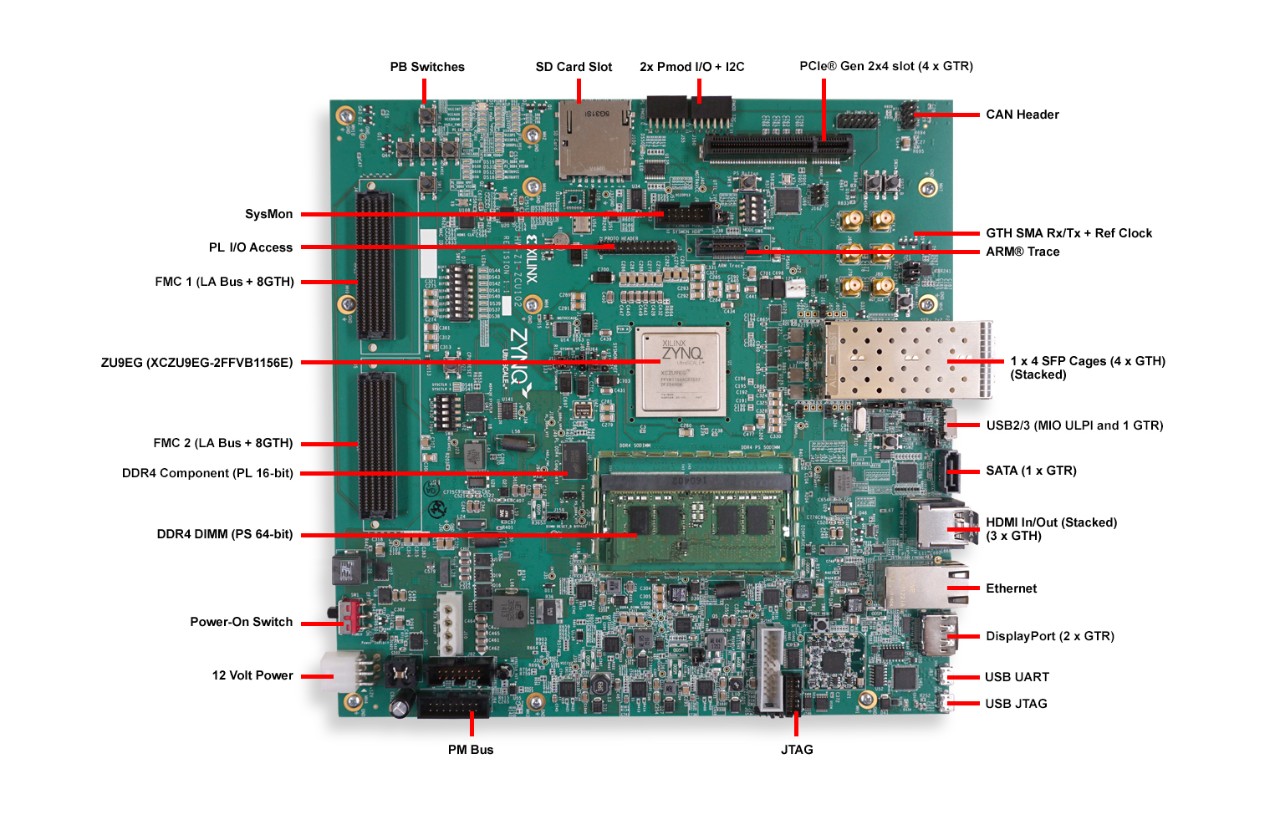
Using Linux as software
Necessary files
Important
Pre-built files for this reference design are not yet available on the Kuiper SD card image. Build them from source, as described below.
The following files are needed for the system to boot, in the root directory of the BOOT partition of the SD card:
HDL boot image:
BOOT.BIN, built from the projects/adar3000/zcu102 HDL projectLinux kernel image:
ImageLinux device tree:
system.dtb, built from adi-adar3000-evb.dts
Instructions on how to build them from source can be found here:
Build ZynqMP / MPSoC Linux kernel and devicetree. The
adi_zynqmp_defconfigconfiguration enables the ADAR3000 driver. Build the device tree withmake xilinx/adi-adar3000-evb.dtband copy it to the SD card assystem.dtb.ADAR3000 HDL project. More HDL build details at Build an HDL project.
Required software
SD card 16 GB imaged with Kuiper
A UART terminal (PuTTY/Tera Term/Minicom, etc.), baud rate 115200 (8N1)
Required hardware
AMD Xilinx ZCU102 FPGA board and its power supply
ADAR3000/3001-EVALZ evaluation board
SDP-I-FMC interposer
Two bench power supplies, see Power supply
SD card with at least 16 GB of memory
Micro-USB cable, for UART
LAN cable (Ethernet), optional, for remote access
More details as to why you need these, can be found at Prerequisites.
Testing
Creating the setup
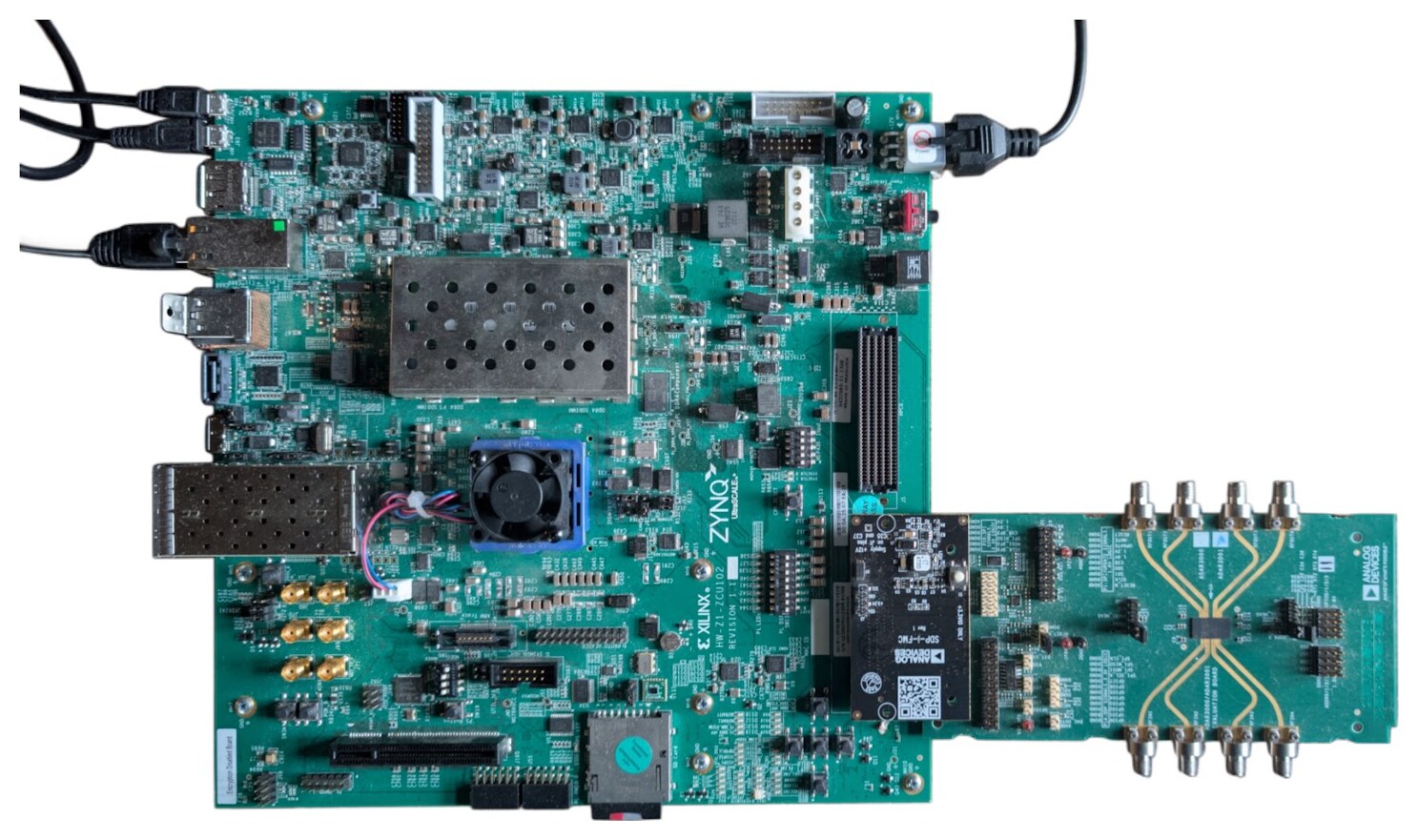
Figure 1 ZCU102 with the SDP-I-FMC interposer on FMC HPC1 and the ADAR3000/3001-EVALZ
All the products described on this page include ESD (electrostatic discharge) sensitive devices. Electrostatic charges as high as 4000V readily accumulate on the human body or test equipment and can discharge without detection. Although the boards feature ESD protection circuitry, permanent damage may occur on devices subjected to high-energy electrostatic discharges. Therefore, proper ESD precautions are recommended to avoid performance degradation or loss of functionality. This includes removing static charge on external equipment, cables, or antennas before connecting to the device.
Follow the steps in this order, to avoid damaging the components:
Get the ZCU102.
Insert the SD card into the SD card slot of the FPGA board.
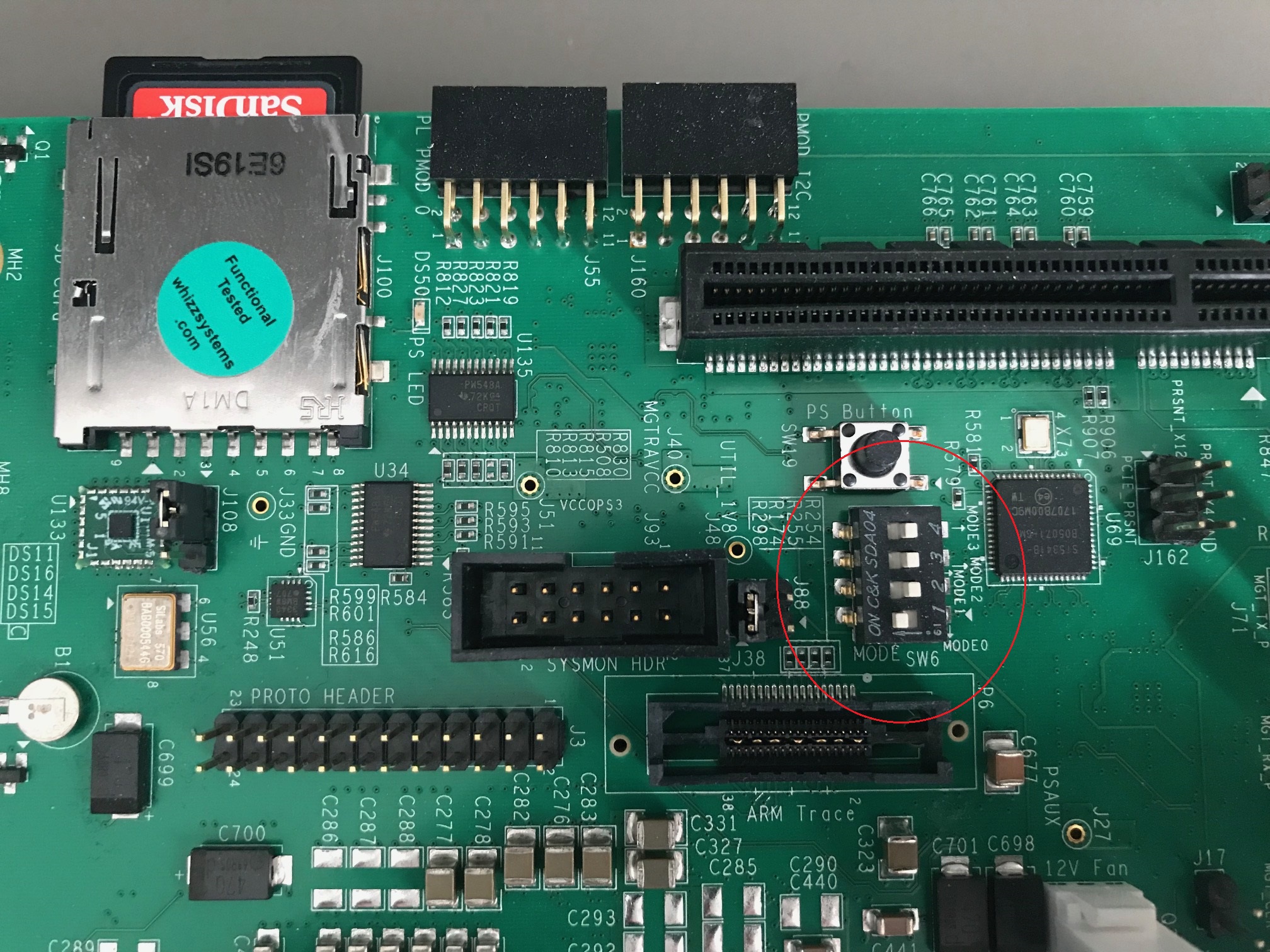
Configure the ZCU102 for SD boot mode (mode switch SW6[4:1] in the position 4-OFF, 3-OFF, 2-OFF, 1-ON).
On the ADAR3000/3001-EVALZ, fit the jumpers on P8 and P9, leave P4 as shipped (pin 1 to pin 2), and make sure P2, P12 and P13 are open, see Hardware configuration.
Connect the SDP-I-FMC interposer to the FPGA carrier FMC HPC1 socket (J4), and the ADAR3000/3001-EVALZ to the interposer’s 120-pin SDP connector, P5.
Connect the bench supplies to the evaluation board test loops, with the outputs off, as described in Power supply.
Connect USB UART (Micro-USB) to your host PC (J83).
Optionally, plug an Ethernet cable from your router or switch into the Ethernet port of the FPGA board.
Plug the power supply into the 12 V power input connector (J52).
Turn on the bench supplies, then the power switch on the FPGA board. The driver checks for the device while Linux boots, so the evaluation board must be powered first.
Make sure the FMC
VADJrail is at 1.8 V, see FMC VADJ.Observe the kernel and serial console messages on your terminal (use the first ttyUSB or COM port the ZCU102 registers).
Boot messages
The following is what is printed in the serial console, after you have connected to the proper ttyUSB or COM port:
Zynq MP First Stage Boot Loader
Release 2025.1   Sep 16 2026  -  14:04:56
NOTICE:  BL31: Non secure code at 0x8000000
NOTICE:  BL31: v2.8(release):xilinx-v2023.2
NOTICE:  BL31: Built : 10:57:16, Feb  7 2024
PMUFW:    v1.1

U-Boot 2018.01-21442-gf06dec3cab (Feb 13 2025 - 17:12:07 +0200) Xilinx ZynqMP ZCU102 revA, Build: jenkins-development-build_uboot-57

I2C:   ready
DRAM:  4 GiB
EL Level: EL2
Chip ID:  zu9eg
MMC:   sdhci@ff170000: 0 (SD)
*** Warning - bad CRC, using default environment

In:    serial@ff000000
Out:   serial@ff000000
Err:   serial@ff000000
Bootmode: LVL_SHFT_SD_MODE1
Net:   ZYNQ GEM: ff0e0000, phyaddr 15, interface rgmii-id

Warning: ethernet@ff0e0000 using MAC address from ROM
eth0: ethernet@ff0e0000
Hit any key to stop autoboot:  2  1  0
switch to partitions #0, OK
mmc0 is current device
Device: sdhci@ff170000
Manufacturer ID: 3
OEM: 5344
Name: SD32G
Tran Speed: 50000000
Rd Block Len: 512
SD version 3.0
High Capacity: Yes
Capacity: 29.7 GiB
Bus Width: 4-bit
Erase Group Size: 512 Bytes
reading uEnv.txt
407 bytes read in 19 ms (20.5 KiB/s)
Loaded environment from uEnv.txt
Importing environment from SD ...
Running uenvcmd ...
Copying Linux from SD to RAM...
** No boot file defined **
reading system.dtb
42326 bytes read in 30 ms (1.3 MiB/s)
reading Image
51814912 bytes read in 3419 ms (14.5 MiB/s)
## Flattened Device Tree blob at 04000000
   Booting using the fdt blob at 0x4000000
   Loading Device Tree to 000000000fff2000, end 000000000ffff555 ... OK

Starting kernel ...

[    0.000000] Booting Linux on physical CPU 0x0000000000 [0x410fd034]
[    0.000000] Linux version 6.12.0-27787-gca3ac7191a94 (user@host) (aarch64-linux-gnu-gcc (Debian 15.2.0-13) 15.2.0, GNU ld (GNU Binutils for Debian) 2.46) #115 SMP Thu Nov 12 13:53:06 EET 2026
[    0.000000] Machine model: ZynqMP ZCU102 Rev1.0
[    0.000000] earlycon: cdns0 at MMIO 0x00000000ff000000 (options '115200n8')
[    0.000000] printk: legacy bootconsole [cdns0] enabled
[    0.000000] efi: UEFI not found.
[    0.000000] OF: reserved mem: 0x000000003ed00000..0x000000003ed3ffff (256 KiB) nomap non-reusable memory@3ed00000
[    0.000000] OF: reserved mem: 0x000000003ef00000..0x000000003ef3ffff (256 KiB) nomap non-reusable memory@3ef00000
[    0.000000] Zone ranges:
[    0.000000]   DMA      [mem 0x0000000000000000-0x00000000ffffffff]
[    0.000000]   DMA32    empty
[    0.000000]   Normal   [mem 0x0000000100000000-0x000000087fffffff]
[    0.000000] Movable zone start for each node
[    0.000000] Early memory node ranges
[    0.000000]   node   0: [mem 0x0000000000000000-0x000000003ecfffff]
[    0.000000]   node   0: [mem 0x000000003ed00000-0x000000003ed3ffff]
[    0.000000]   node   0: [mem 0x000000003ed40000-0x000000003eefffff]
[    0.000000]   node   0: [mem 0x000000003ef00000-0x000000003ef3ffff]
[    0.000000]   node   0: [mem 0x000000003ef40000-0x000000007fffffff]
[    0.000000]   node   0: [mem 0x0000000800000000-0x000000087fffffff]
[    0.000000] Initmem setup node 0 [mem 0x0000000000000000-0x000000087fffffff]
[    0.000000] cma: Reserved 256 MiB at 0x0000000070000000 on node -1
[    0.000000] psci: probing for conduit method from DT.
[    0.000000] psci: PSCIv1.1 detected in firmware.
[    0.000000] psci: Using standard PSCI v0.2 function IDs
[    0.000000] psci: MIGRATE_INFO_TYPE not supported.
[    0.000000] psci: SMC Calling Convention v1.2
[    0.000000] percpu: Embedded 29 pages/cpu s79704 r8192 d30888 u118784
[    0.000000] Detected VIPT I-cache on CPU0
[    0.000000] CPU features: detected: ARM erratum 845719
[    0.000000] alternatives: applying boot alternatives
[    0.000000] Kernel command line: console=ttyPS0,115200 root=/dev/mmcblk0p2 rw earlycon rootfstype=ext4 rootwait clk_ignore_unused cpuidle.off=1 root=/dev/mmcblk0p2 rw rootwait
[    0.000000] Dentry cache hash table entries: 524288 (order: 10, 4194304 bytes, linear)
[    0.000000] Inode-cache hash table entries: 262144 (order: 9, 2097152 bytes, linear)
[    0.000000] Built 1 zonelists, mobility grouping on.  Total pages: 1048576
[    0.000000] mem auto-init: stack:all(zero), heap alloc:off, heap free:off
[    0.000000] software IO TLB: area num 4.
[    0.000000] software IO TLB: mapped [mem 0x000000006c000000-0x0000000070000000] (64MB)
[    0.000000] SLUB: HWalign=64, Order=0-3, MinObjects=0, CPUs=4, Nodes=1
[    0.000000] trace event string verifier disabled
[    0.000000] rcu: Hierarchical RCU implementation.
[    0.000000] rcu:       RCU event tracing is enabled.
[    0.000000] rcu:       RCU restricting CPUs from NR_CPUS=8 to nr_cpu_ids=4.
[    0.000000] rcu: RCU calculated value of scheduler-enlistment delay is 25 jiffies.
[    0.000000] rcu: Adjusting geometry for rcu_fanout_leaf=16, nr_cpu_ids=4
[    0.000000] NR_IRQS: 64, nr_irqs: 64, preallocated irqs: 0
[    0.000000] GIC: Adjusting CPU interface base to 0x00000000f902f000
[    0.000000] Root IRQ handler: gic_handle_irq
[    0.000000] GIC: Using split EOI/Deactivate mode
[    0.000000] rcu: srcu_init: Setting srcu_struct sizes based on contention.
[    0.000000] arch_timer: cp15 timer(s) running at 100.00MHz (phys).
[    0.000000] clocksource: arch_sys_counter: mask: 0x1ffffffffffffff max_cycles: 0x171024e7e0, max_idle_ns: 440795205315 ns
[    0.000000] sched_clock: 57 bits at 100MHz, resolution 10ns, wraps every 4398046511100ns
[    0.008336] Console: colour dummy device 80x25
[    0.012489] Calibrating delay loop (skipped), value calculated using timer frequency.. 200.00 BogoMIPS (lpj=400000)
[    0.022840] pid_max: default: 32768 minimum: 301
[    0.027522] Mount-cache hash table entries: 8192 (order: 4, 65536 bytes, linear)
[    0.034786] Mountpoint-cache hash table entries: 8192 (order: 4, 65536 bytes, linear)
[    0.070654] rcu: Hierarchical SRCU implementation.
[    0.070701] rcu:       Max phase no-delay instances is 1000.
[    0.075233] Timer migration: 1 hierarchy levels; 8 children per group; 1 crossnode level
[    0.083160] EFI services will not be available.
[    0.087721] smp: Bringing up secondary CPUs ...
[    0.092459] Detected VIPT I-cache on CPU1
[    0.092525] CPU1: Booted secondary processor 0x0000000001 [0x410fd034]
[    0.092981] Detected VIPT I-cache on CPU2
[    0.093027] CPU2: Booted secondary processor 0x0000000002 [0x410fd034]
[    0.093461] Detected VIPT I-cache on CPU3
[    0.093506] CPU3: Booted secondary processor 0x0000000003 [0x410fd034]
[    0.093569] smp: Brought up 1 node, 4 CPUs
[    0.127503] SMP: Total of 4 processors activated.
[    0.132174] CPU: All CPU(s) started at EL2
[    0.136241] CPU features: detected: 32-bit EL0 Support
[    0.141345] CPU features: detected: CRC32 instructions
[    0.146481] alternatives: applying system-wide alternatives
[    0.152963] Memory: 3727940K/4194304K available (23872K kernel code, 3368K rwdata, 21436K rodata, 1792K init, 750K bss, 199848K reserved, 262144K cma-reserved)
[    0.166878] devtmpfs: initialized
[    0.174979] clocksource: jiffies: mask: 0xffffffff max_cycles: 0xffffffff, max_idle_ns: 7645041785100000 ns
[    0.179157] futex hash table entries: 1024 (order: 4, 65536 bytes, linear)
[    0.191627] 19904 pages in range for non-PLT usage
[    0.191645] 511424 pages in range for PLT usage
[    0.191794] pinctrl core: initialized pinctrl subsystem
[    0.201612] NET: Registered PF_NETLINK/PF_ROUTE protocol family
[    0.207092] DMA: preallocated 512 KiB GFP_KERNEL pool for atomic allocations
[    0.213476] DMA: preallocated 512 KiB GFP_KERNEL|GFP_DMA pool for atomic allocations
[    0.221332] DMA: preallocated 512 KiB GFP_KERNEL|GFP_DMA32 pool for atomic allocations
[    0.228976] audit: initializing netlink subsys (disabled)
[    0.234426] audit: type=2000 audit(0.156:1): state=initialized audit_enabled=0 res=1
[    0.234811] hw-breakpoint: found 6 breakpoint and 4 watchpoint registers.
[    0.248830] ASID allocator initialised with 65536 entries
[    0.263177] platform fd0e0000.pcie: Fixed dependency cycle(s) with /axi/pcie@fd0e0000
[    0.265417] platform fd0e0000.pcie: Fixed dependency cycle(s) with /axi/pcie@fd0e0000/legacy-interrupt-controller
[    0.279140] platform fd4a0000.display: Fixed dependency cycle(s) with /dpcon
[    0.282634] platform dpcon: Fixed dependency cycle(s) with /axi/display@fd4a0000
[    0.293341] HugeTLB: registered 1.00 GiB page size, pre-allocated 0 pages
[    0.296676] HugeTLB: 0 KiB vmemmap can be freed for a 1.00 GiB page
[    0.302914] HugeTLB: registered 32.0 MiB page size, pre-allocated 0 pages
[    0.309655] HugeTLB: 0 KiB vmemmap can be freed for a 32.0 MiB page
[    0.315884] HugeTLB: registered 2.00 MiB page size, pre-allocated 0 pages
[    0.322629] HugeTLB: 0 KiB vmemmap can be freed for a 2.00 MiB page
[    0.328859] HugeTLB: registered 64.0 KiB page size, pre-allocated 0 pages
[    0.335604] HugeTLB: 0 KiB vmemmap can be freed for a 64.0 KiB page
[    0.410071] raid6: neonx8   gen()  2231 MB/s
[    0.478136] raid6: neonx4   gen()  2199 MB/s
[    0.546199] raid6: neonx2   gen()  2094 MB/s
[    0.614262] raid6: neonx1   gen()  1811 MB/s
[    0.682336] raid6: int64x8  gen()  1104 MB/s
[    0.750403] raid6: int64x4  gen()  1565 MB/s
[    0.818473] raid6: int64x2  gen()  1440 MB/s
[    0.886536] raid6: int64x1  gen()   975 MB/s
[    0.886577] raid6: using algorithm neonx8 gen() 2231 MB/s
[    0.958603] raid6: .... xor() 1654 MB/s, rmw enabled
[    0.958649] raid6: using neon recovery algorithm
[    0.962955] iommu: Default domain type: Translated
[    0.967274] iommu: DMA domain TLB invalidation policy: strict mode
[    0.979979] SCSI subsystem initialized
[    0.980175] usbcore: registered new interface driver usbfs
[    0.983568] usbcore: registered new interface driver hub
[    0.988840] usbcore: registered new device driver usb
[    0.994022] mc: Linux media interface: v0.10
[    0.998104] videodev: Linux video capture interface: v2.00
[    1.003570] pps_core: LinuxPPS API ver. 1 registered
[    1.008454] pps_core: Software ver. 5.3.6 - Copyright 2005-2007 Rodolfo Giometti <giometti@linux.it>
[    1.017548] PTP clock support registered
[    1.021453] EDAC MC: Ver: 3.0.0
[    1.024870] zynqmp-ipi-mbox mailbox@ff9905c0: Registered ZynqMP IPI mbox with TX/RX channels.
[    1.033515] jesd204: found 0 devices and 0 topologies
[    1.038106] FPGA manager framework
[    1.041442] Advanced Linux Sound Architecture Driver Initialized.
[    1.048057] Bluetooth: Core ver 2.22
[    1.051024] NET: Registered PF_BLUETOOTH protocol family
[    1.056290] Bluetooth: HCI device and connection manager initialized
[    1.062607] Bluetooth: HCI socket layer initialized
[    1.067449] Bluetooth: L2CAP socket layer initialized
[    1.072472] Bluetooth: SCO socket layer initialized
[    1.077735] vgaarb: loaded
[    1.081848] clocksource: Switched to clocksource arch_sys_counter
[    1.086285] VFS: Disk quotas dquot_6.6.0
[    1.089953] VFS: Dquot-cache hash table entries: 512 (order 0, 4096 bytes)
[    1.102768] NET: Registered PF_INET protocol family
[    1.102972] IP idents hash table entries: 65536 (order: 7, 524288 bytes, linear)
[    1.112111] tcp_listen_portaddr_hash hash table entries: 2048 (order: 3, 32768 bytes, linear)
[    1.117872] Table-perturb hash table entries: 65536 (order: 6, 262144 bytes, linear)
[    1.125547] TCP established hash table entries: 32768 (order: 6, 262144 bytes, linear)
[    1.133617] TCP bind hash table entries: 32768 (order: 8, 1048576 bytes, linear)
[    1.141564] TCP: Hash tables configured (established 32768 bind 32768)
[    1.147326] UDP hash table entries: 2048 (order: 4, 65536 bytes, linear)
[    1.153986] UDP-Lite hash table entries: 2048 (order: 4, 65536 bytes, linear)
[    1.161157] NET: Registered PF_UNIX/PF_LOCAL protocol family
[    1.167059] RPC: Registered named UNIX socket transport module.
[    1.172516] RPC: Registered udp transport module.
[    1.177183] RPC: Registered tcp transport module.
[    1.181853] RPC: Registered tcp-with-tls transport module.
[    1.187302] RPC: Registered tcp NFSv4.1 backchannel transport module.
[    1.194852] PCI: CLS 0 bytes, default 64
[    1.198516] Initialise system trusted keyrings
[    1.202132] workingset: timestamp_bits=62 max_order=20 bucket_order=0
[    1.208886] NFS: Registering the id_resolver key type
[    1.213443] Key type id_resolver registered
[    1.217580] Key type id_legacy registered
[    1.221579] nfs4filelayout_init: NFSv4 File Layout Driver Registering...
[    1.228224] nfs4flexfilelayout_init: NFSv4 Flexfile Layout Driver Registering...
[    1.235585] jffs2: version 2.2. (NAND) (SUMMARY)  © 2001-2006 Red Hat, Inc.
[    1.242697] fuse: init (API version 7.41)
[    1.302518] NET: Registered PF_ALG protocol family
[    1.302568] xor: measuring software checksum speed
[    1.307648]    8regs           :  2699 MB/sec
[    1.311969]    32regs          :  2703 MB/sec
[    1.316467]    arm64_neon      :  2367 MB/sec
[    1.319406] xor: using function: 32regs (2703 MB/sec)
[    1.324426] Key type asymmetric registered
[    1.328492] Asymmetric key parser 'x509' registered
[    1.333369] Block layer SCSI generic (bsg) driver version 0.4 loaded (major 246)
[    1.340689] io scheduler mq-deadline registered
[    1.345185] io scheduler kyber registered
[    1.349172] io scheduler bfq registered
[    1.356996] ledtrig-cpu: registered to indicate activity on CPUs
[    1.395920] Serial: 8250/16550 driver, 4 ports, IRQ sharing disabled
[    1.404285] brd: module loaded
[    1.407682] loop: module loaded
[    1.408113] Registered mathworks_ip class
[    1.409706] mtdoops: mtd device (mtddev=name/number) must be supplied
[    1.418977] tun: Universal TUN/TAP device driver, 1.6
[    1.420694] CAN device driver interface
[    1.424991] SPI driver wl1271_spi has no spi_device_id for ti,wl1271
[    1.430718] SPI driver wl1271_spi has no spi_device_id for ti,wl1273
[    1.437030] SPI driver wl1271_spi has no spi_device_id for ti,wl1281
[    1.443351] SPI driver wl1271_spi has no spi_device_id for ti,wl1283
[    1.449658] SPI driver wl1271_spi has no spi_device_id for ti,wl1285
[    1.455978] SPI driver wl1271_spi has no spi_device_id for ti,wl1801
[    1.462291] SPI driver wl1271_spi has no spi_device_id for ti,wl1805
[    1.468601] SPI driver wl1271_spi has no spi_device_id for ti,wl1807
[    1.474919] SPI driver wl1271_spi has no spi_device_id for ti,wl1831
[    1.481230] SPI driver wl1271_spi has no spi_device_id for ti,wl1835
[    1.487548] SPI driver wl1271_spi has no spi_device_id for ti,wl1837
[    1.493966] usbcore: registered new interface driver asix
[    1.499242] usbcore: registered new interface driver ax88179_178a
[    1.505300] usbcore: registered new interface driver cdc_ether
[    1.511097] usbcore: registered new interface driver net1080
[    1.516719] usbcore: registered new interface driver cdc_subset
[    1.522603] usbcore: registered new interface driver zaurus
[    1.528134] usbcore: registered new interface driver cdc_ncm
[    1.533761] usbcore: registered new interface driver r8153_ecm
[    1.540698] usbcore: registered new interface driver uas
[    1.544835] usbcore: registered new interface driver usb-storage
[    1.550830] usbcore: registered new interface driver usbserial_generic
[    1.557281] usbserial: USB Serial support registered for generic
[    1.563252] usbcore: registered new interface driver ftdi_sio
[    1.568957] usbserial: USB Serial support registered for FTDI USB Serial Device
[    1.576228] usbcore: registered new interface driver upd78f0730
[    1.582104] usbserial: USB Serial support registered for upd78f0730
[    1.590002] rtc_zynqmp ffa60000.rtc: registered as rtc0
[    1.593512] rtc_zynqmp ffa60000.rtc: setting system clock to 2026-11-12T11:47:02 UTC (1794484022)
[    1.602397] i2c_dev: i2c /dev entries driver
[    1.607205] usbcore: registered new interface driver uvcvideo
[    1.613734] Bluetooth: HCI UART driver ver 2.3
[    1.616696] Bluetooth: HCI UART protocol H4 registered
[    1.621797] Bluetooth: HCI UART protocol BCSP registered
[    1.627094] Bluetooth: HCI UART protocol LL registered
[    1.632174] Bluetooth: HCI UART protocol ATH3K registered
[    1.637554] Bluetooth: HCI UART protocol Three-wire (H5) registered
[    1.643808] Bluetooth: HCI UART protocol Intel registered
[    1.649142] Bluetooth: HCI UART protocol QCA registered
[    1.654342] usbcore: registered new interface driver bcm203x
[    1.659958] usbcore: registered new interface driver bpa10x
[    1.665503] usbcore: registered new interface driver bfusb
[    1.670949] usbcore: registered new interface driver btusb
[    1.676407] usbcore: registered new interface driver ath3k
[    1.681931] EDAC MC: ECC not enabled
[    1.685695] sdhci: Secure Digital Host Controller Interface driver
[    1.691520] sdhci: Copyright(c) Pierre Ossman
[    1.695837] sdhci-pltfm: SDHCI platform and OF driver helper
[    1.701715] SMCCC: SOC_ID: ID = jep106:0049:0000 Revision = 0x24738093
[    1.708030] zynqmp_firmware_probe Platform Management API v1.1
[    1.713775] zynqmp_firmware_probe Trustzone version v1.0
[    1.749513] zynqmp-aes zynqmp-aes.0: AES is not supported on the platform
[    1.750680] zynqmp-aes zynqmp-aes.0: probe with driver zynqmp-aes failed with error -95
[    1.758772] zynqmp_rsa zynqmp_rsa.0: RSA is not supported on the platform
[    1.765378] zynqmp_rsa zynqmp_rsa.0: probe with driver zynqmp_rsa failed with error -95
[    1.773440] usbcore: registered new interface driver usbhid
[    1.778876] usbhid: USB HID core driver
[    1.782825] SPI driver fb_seps525 has no spi_device_id for syncoam,seps525
[    1.798131] hw perfevents: enabled with armv8_cortex_a53 PMU driver, 7 (0,8000003f) counters available
[    1.802938] fpga_manager fpga0: Xilinx ZynqMP FPGA Manager registered
[    1.808571] usbcore: registered new interface driver snd-usb-audio
[    1.815879] pktgen: Packet Generator for packet performance testing. Version: 2.75
[    1.822391] Initializing XFRM netlink socket
[    1.826163] NET: Registered PF_INET6 protocol family
[    1.831614] Segment Routing with IPv6
[    1.834700] In-situ OAM (IOAM) with IPv6
[    1.838608] sit: IPv6, IPv4 and MPLS over IPv4 tunneling driver
[    1.844795] NET: Registered PF_PACKET protocol family
[    1.849462] NET: Registered PF_KEY protocol family
[    1.854323] can: controller area network core
[    1.858560] NET: Registered PF_CAN protocol family
[    1.863296] can: raw protocol
[    1.866237] can: broadcast manager protocol
[    1.870390] can: netlink gateway - max_hops=1
[    1.874801] Bluetooth: RFCOMM TTY layer initialized
[    1.879561] Bluetooth: RFCOMM socket layer initialized
[    1.884670] Bluetooth: RFCOMM ver 1.11
[    1.888382] Bluetooth: BNEP (Ethernet Emulation) ver 1.3
[    1.893653] Bluetooth: BNEP filters: protocol multicast
[    1.898846] Bluetooth: BNEP socket layer initialized
[    1.903776] Bluetooth: HIDP (Human Interface Emulation) ver 1.2
[    1.909660] Bluetooth: HIDP socket layer initialized
[    1.914771] 9pnet: Installing 9P2000 support
[    1.918837] NET: Registered PF_IEEE802154 protocol family
[    1.924209] Key type dns_resolver registered
[    1.936569] registered taskstats version 1
[    1.936612] Loading compiled-in X.509 certificates
[    1.945621] Btrfs loaded, zoned=no, fsverity=no
[    1.958434] ff000000.serial: ttyPS0 at MMIO 0xff000000 (irq = 22, base_baud = 6249999) is a xuartps
[    1.967470] printk: legacy console [ttyPS0] enabled
[    1.967470] printk: legacy console [ttyPS0] enabled
[    1.972393] printk: legacy bootconsole [cdns0] disabled
[    1.972393] printk: legacy bootconsole [cdns0] disabled
[    1.985207] ff010000.serial: ttyPS1 at MMIO 0xff010000 (irq = 23, base_baud = 6249999) is a xuartps
[    2.041425] xilinx-zynqmp-dpdma fd4c0000.dma-controller: Xilinx DPDMA engine is probed
[    2.053319] spi-nor spi0.0: SPI-NOR-UniqueID e00d0e000b0000270050826cb362
[    2.060125] spi-nor spi0.0: found mt25qu512a, expected m25p80
[    2.066269] 4 fixed-partitions partitions found on MTD device spi0.0
[    2.072620] Creating 4 MTD partitions on "spi0.0":
[    2.077413] 0x000000000000-0x000000100000 : "qspi-fsbl-uboot"
[    2.084049] 0x000000100000-0x000000600000 : "qspi-linux"
[    2.090141] 0x000000600000-0x000000620000 : "qspi-device-tree"
[    2.096721] 0x000000620000-0x000000c00000 : "qspi-rootfs"
[    2.107824] xilinx-axipmon ffa00000.perf-monitor: Probed Xilinx APM
[    2.114576] xilinx-axipmon fd0b0000.perf-monitor: Probed Xilinx APM
[    2.121190] xilinx-axipmon fd490000.perf-monitor: Probed Xilinx APM
[    2.127788] xilinx-axipmon ffa10000.perf-monitor: Probed Xilinx APM
[    2.135105] i2c i2c-0: using pinctrl states for GPIO recovery
[    2.141037] i2c i2c-0: using generic GPIOs for recovery
[    2.146682] pca953x 0-0020: supply vcc not found, using dummy regulator
[    2.153387] pca953x 0-0020: using no AI
[    2.159007] pca953x 0-0021: supply vcc not found, using dummy regulator
[    2.165700] pca953x 0-0021: using no AI
[    2.170463] pca954x 0-0075: supply vdd not found, using dummy regulator
[    2.177655] ina2xx 2-0040: supply vs not found, using dummy regulator
[    2.184784] ina2xx 2-0040: power monitor ina226 (Rshunt = 5000 uOhm)
[    2.191385] ina2xx 2-0041: supply vs not found, using dummy regulator
[    2.198431] ina2xx 2-0041: power monitor ina226 (Rshunt = 5000 uOhm)
[    2.205015] ina2xx 2-0042: supply vs not found, using dummy regulator
[    2.212050] ina2xx 2-0042: power monitor ina226 (Rshunt = 5000 uOhm)
[    2.218652] ina2xx 2-0043: supply vs not found, using dummy regulator
[    2.225694] ina2xx 2-0043: power monitor ina226 (Rshunt = 5000 uOhm)
[    2.232279] ina2xx 2-0044: supply vs not found, using dummy regulator
[    2.239381] ina2xx 2-0044: power monitor ina226 (Rshunt = 5000 uOhm)
[    2.245997] ina2xx 2-0045: supply vs not found, using dummy regulator
[    2.253030] ina2xx 2-0045: power monitor ina226 (Rshunt = 5000 uOhm)
[    2.259619] ina2xx 2-0046: supply vs not found, using dummy regulator
[    2.266660] ina2xx 2-0046: power monitor ina226 (Rshunt = 5000 uOhm)
[    2.273269] ina2xx 2-0047: supply vs not found, using dummy regulator
[    2.280311] ina2xx 2-0047: power monitor ina226 (Rshunt = 5000 uOhm)
[    2.286906] ina2xx 2-004a: supply vs not found, using dummy regulator
[    2.293957] ina2xx 2-004a: power monitor ina226 (Rshunt = 5000 uOhm)
[    2.300560] ina2xx 2-004b: supply vs not found, using dummy regulator
[    2.307604] ina2xx 2-004b: power monitor ina226 (Rshunt = 5000 uOhm)
[    2.314040] i2c i2c-0: Added multiplexed i2c bus 2
[    2.319254] ina2xx 3-0040: supply vs not found, using dummy regulator
[    2.326387] ina2xx 3-0040: power monitor ina226 (Rshunt = 2000 uOhm)
[    2.332998] ina2xx 3-0041: supply vs not found, using dummy regulator
[    2.340038] ina2xx 3-0041: power monitor ina226 (Rshunt = 5000 uOhm)
[    2.346642] ina2xx 3-0042: supply vs not found, using dummy regulator
[    2.353688] ina2xx 3-0042: power monitor ina226 (Rshunt = 5000 uOhm)
[    2.360303] ina2xx 3-0043: supply vs not found, using dummy regulator
[    2.367350] ina2xx 3-0043: power monitor ina226 (Rshunt = 5000 uOhm)
[    2.373959] ina2xx 3-0044: supply vs not found, using dummy regulator
[    2.380995] ina2xx 3-0044: power monitor ina226 (Rshunt = 5000 uOhm)
[    2.387608] ina2xx 3-0045: supply vs not found, using dummy regulator
[    2.394653] ina2xx 3-0045: power monitor ina226 (Rshunt = 5000 uOhm)
[    2.401244] ina2xx 3-0046: supply vs not found, using dummy regulator
[    2.408292] ina2xx 3-0046: power monitor ina226 (Rshunt = 5000 uOhm)
[    2.414895] ina2xx 3-0047: supply vs not found, using dummy regulator
[    2.421980] ina2xx 3-0047: power monitor ina226 (Rshunt = 5000 uOhm)
[    2.428399] i2c i2c-0: Added multiplexed i2c bus 3
[    2.480896] i2c i2c-0: Added multiplexed i2c bus 4
[    2.485887] i2c i2c-0: Added multiplexed i2c bus 5
[    2.490680] pca954x 0-0075: registered 4 multiplexed busses for I2C mux pca9544
[    2.498080] cdns-i2c ff020000.i2c: 400 kHz mmio ff020000 irq 40
[    2.505110] i2c i2c-1: using pinctrl states for GPIO recovery
[    2.511053] i2c i2c-1: using generic GPIOs for recovery
[    2.516688] pca954x 1-0074: supply vdd not found, using dummy regulator
[    2.523788] at24 6-0054: supply vcc not found, using dummy regulator
[    2.530711] at24 6-0054: 1024 byte 24c08 EEPROM, writable, 1 bytes/write
[    2.537475] i2c i2c-1: Added multiplexed i2c bus 6
[    2.542879] si5341 7-0036: no regulator set, defaulting vdd_sel to 2.5V for out
[    2.550196] si5341 7-0036: no regulator set, defaulting vdd_sel to 2.5V for out
[    2.557508] si5341 7-0036: no regulator set, defaulting vdd_sel to 2.5V for out
[    2.564823] si5341 7-0036: no regulator set, defaulting vdd_sel to 2.5V for out
[    2.572133] si5341 7-0036: no regulator set, defaulting vdd_sel to 2.5V for out
[    2.579441] si5341 7-0036: no regulator set, defaulting vdd_sel to 2.5V for out
[    2.586753] si5341 7-0036: no regulator set, defaulting vdd_sel to 2.5V for out
[    2.594068] si5341 7-0036: no regulator set, defaulting vdd_sel to 2.5V for out
[    2.602152] si5341 7-0036: Chip: 5341 Grade: 1 Rev: 3
[    2.631159] i2c i2c-1: Added multiplexed i2c bus 7
[    2.638244] si570 8-005d: registered, current frequency 300000000 Hz
[    2.644664] i2c i2c-1: Added multiplexed i2c bus 8
[    2.651700] si570 9-005d: registered, current frequency 156250000 Hz
[    2.658116] i2c i2c-1: Added multiplexed i2c bus 9
[    2.663167] si5324 10-0069: si5328 probed
[    2.719674] si5324 10-0069: si5328 probe successful
[    2.724613] i2c i2c-1: Added multiplexed i2c bus 10
[    2.729687] i2c i2c-1: Added multiplexed i2c bus 11
[    2.734748] i2c i2c-1: Added multiplexed i2c bus 12
[    2.739807] i2c i2c-1: Added multiplexed i2c bus 13
[    2.744696] pca954x 1-0074: registered 8 multiplexed busses for I2C switch pca9548
[    2.752467] pca954x 1-0075: supply vdd not found, using dummy regulator
[    2.759444] i2c i2c-1: Added multiplexed i2c bus 14
[    2.764508] i2c i2c-1: Added multiplexed i2c bus 15
[    2.769572] i2c i2c-1: Added multiplexed i2c bus 16
[    2.774652] i2c i2c-1: Added multiplexed i2c bus 17
[    2.779715] i2c i2c-1: Added multiplexed i2c bus 18
[    2.784776] i2c i2c-1: Added multiplexed i2c bus 19
[    2.789870] i2c i2c-1: Added multiplexed i2c bus 20
[    2.794929] i2c i2c-1: Added multiplexed i2c bus 21
[    2.799810] pca954x 1-0075: registered 8 multiplexed busses for I2C switch pca9548
[    2.807445] cdns-i2c ff030000.i2c: 400 kHz mmio ff030000 irq 41
[    2.817071] cdns-wdt fd4d0000.watchdog: Xilinx Watchdog Timer with timeout 60s
[    2.825423] nwl-pcie fd0e0000.pcie: host bridge /axi/pcie@fd0e0000 ranges:
[    2.832342] nwl-pcie fd0e0000.pcie:      MEM 0x00e0000000..0x00efffffff -> 0x00e0000000
[    2.840376] nwl-pcie fd0e0000.pcie:      MEM 0x0600000000..0x07ffffffff -> 0x0600000000
[    2.848512] nwl-pcie fd0e0000.pcie: Link is DOWN
[    2.853577] nwl-pcie fd0e0000.pcie: PCI host bridge to bus 0000:00
[    2.859764] pci_bus 0000:00: root bus resource [bus 00-ff]
[    2.865252] pci_bus 0000:00: root bus resource [mem 0xe0000000-0xefffffff]
[    2.872125] pci_bus 0000:00: root bus resource [mem 0x600000000-0x7ffffffff pref]
[    2.879632] pci 0000:00:00.0: [10ee:d021] type 01 class 0x060400 PCIe Root Port
[    2.886958] pci 0000:00:00.0: PCI bridge to [bus 00]
[    2.891919] pci 0000:00:00.0:   bridge window [mem 0x00000000-0x000fffff]
[    2.898708] pci 0000:00:00.0:   bridge window [mem 0x00000000-0x000fffff 64bit pref]
[    2.906490] pci 0000:00:00.0: PME# supported from D0 D1 D2 D3hot
[    2.914513] pci 0000:00:00.0: bridge configuration invalid ([bus 00-00]), reconfiguring
[    2.922648] pci_bus 0000:01: busn_res: [bus 01-ff] end is updated to 01
[    2.929279] pci 0000:00:00.0: PCI bridge to [bus 01]
[    2.934246] pci_bus 0000:00: resource 4 [mem 0xe0000000-0xefffffff]
[    2.940515] pci_bus 0000:00: resource 5 [mem 0x600000000-0x7ffffffff pref]
[    2.948938] [drm] Initialized zynqmp-dpsub 1.0.0 for fd4a0000.display on minor 0
[    2.981433] mmc0: SDHCI controller on ff170000.mmc [ff170000.mmc] using ADMA 64-bit
[    3.031772] mmc0: new high speed SDHC card at address 5048
[    3.037649] mmcblk0: mmc0:5048 SD32G 29.7 GiB
[    3.044340]  mmcblk0: p1 p2 p3
[    3.993880] zynqmp-dpsub fd4a0000.display: [drm] Cannot find any crtc or sizes
[    4.001154] zynqmp-dpsub fd4a0000.display: ZynqMP DisplayPort Subsystem driver probed
[    4.009333] ahci-ceva fd0c0000.ahci: supply ahci not found, using dummy regulator
[    4.016914] ahci-ceva fd0c0000.ahci: supply phy not found, using dummy regulator
[    4.024395] ahci-ceva fd0c0000.ahci: supply target not found, using dummy regulator
[    4.032310] ahci-ceva fd0c0000.ahci: AHCI vers 0001.0301, 32 command slots, 6 Gbps, platform mode
[    4.041190] ahci-ceva fd0c0000.ahci: 2/2 ports implemented (port mask 0x3)
[    4.048076] ahci-ceva fd0c0000.ahci: flags: 64bit ncq sntf pm clo only pmp fbs pio slum part ccc sds apst
[    4.058737] scsi host0: ahci-ceva
[    4.062385] scsi host1: ahci-ceva
[    4.065802] ata1: SATA max UDMA/133 mmio [mem 0xfd0c0000-0xfd0c1fff] port 0x100 irq 49 lpm-pol 0
[    4.074588] ata2: SATA max UDMA/133 mmio [mem 0xfd0c0000-0xfd0c1fff] port 0x180 irq 49 lpm-pol 0
[    4.087512] macb ff0e0000.ethernet eth0: Cadence GEM rev 0x50070106 at 0xff0e0000 irq 37 (00:0a:35:07:ea:2e)
[    4.114766] xhci-hcd xhci-hcd.1.auto: xHCI Host Controller
[    4.120275] xhci-hcd xhci-hcd.1.auto: new USB bus registered, assigned bus number 1
[    4.128042] xhci-hcd xhci-hcd.1.auto: hcc params 0x0238f625 hci version 0x100 quirks 0x0000808002000810
[    4.137477] xhci-hcd xhci-hcd.1.auto: irq 50, io mem 0xfe200000
[    4.143497] xhci-hcd xhci-hcd.1.auto: xHCI Host Controller
[    4.148989] xhci-hcd xhci-hcd.1.auto: new USB bus registered, assigned bus number 2
[    4.156649] xhci-hcd xhci-hcd.1.auto: Host supports USB 3.0 SuperSpeed
[    4.163323] usb usb1: New USB device found, idVendor=1d6b, idProduct=0002, bcdDevice= 6.12
[    4.171594] usb usb1: New USB device strings: Mfr=3, Product=2, SerialNumber=1
[    4.178812] usb usb1: Product: xHCI Host Controller
[    4.183689] usb usb1: Manufacturer: Linux 6.12.0-27787-gca3ac7191a94 xhci-hcd
[    4.190815] usb usb1: SerialNumber: xhci-hcd.1.auto
[    4.196059] hub 1-0:1.0: USB hub found
[    4.199835] hub 1-0:1.0: 1 port detected
[    4.204126] usb usb2: New USB device found, idVendor=1d6b, idProduct=0003, bcdDevice= 6.12
[    4.212388] usb usb2: New USB device strings: Mfr=3, Product=2, SerialNumber=1
[    4.219611] usb usb2: Product: xHCI Host Controller
[    4.224489] usb usb2: Manufacturer: Linux 6.12.0-27787-gca3ac7191a94 xhci-hcd
[    4.231637] usb usb2: SerialNumber: xhci-hcd.1.auto
[    4.236854] hub 2-0:1.0: USB hub found
[    4.240620] hub 2-0:1.0: 1 port detected
[    4.251669] input: gpio-keys as /devices/platform/gpio-keys/input/input0
[    4.258788] of_cfs_init
[    4.261243] of_cfs_init: OK
[    4.264130] cfg80211: Loading compiled-in X.509 certificates for regulatory database
[    4.306168] Loaded X.509 cert 'sforshee: 00b28ddf47aef9cea7'
[    4.312562] Loaded X.509 cert 'wens: 61c038651aabdcf94bd0ac7ff06c7248db18c600'
[    4.319907] platform regulatory.0: Direct firmware load for regulatory.db failed with error -2
[    4.321966] clk: Not disabling unused clocks
[    4.328531] cfg80211: failed to load regulatory.db
[    4.332776] PM: genpd: Disabling unused power domains
[    4.342948] ALSA device list:
[    4.345911]   No soundcards found.
[    4.397853] ata2: SATA link down (SStatus 0 SControl 330)
[    4.403279] ata1: SATA link down (SStatus 0 SControl 330)
[    4.420518] EXT4-fs (mmcblk0p2): warning: mounting fs with errors, running e2fsck is recommended
[    4.431323] EXT4-fs (mmcblk0p2): mounted filesystem 8f241631-1e44-4030-ae61-cad693793a80 r/w with ordered data mode. Quota mode: none.
[    4.443445] VFS: Mounted root (ext4 filesystem) on device 179:2.
[    4.456778] devtmpfs: mounted
[    4.460208] Freeing unused kernel memory: 1792K
[    4.464784] Run /sbin/init as init process
[    4.975785] systemd[1]: Failed to look up module alias 'autofs4': Function not implemented
[    5.009410] systemd[1]: systemd 247.3-7+rpi1+deb11u2 running in system mode. (+PAM +AUDIT +SELINUX +IMA +APPARMOR +SMACK +SYSVINIT +UTMP +LIBCRYPTSETUP +GCRYPT +GNUTLS +ACL +XZ +LZ4 +ZSTD +SECCOMP +BLKID +ELFUTILS +KMOD +IDN2 -IDN +PCRE2 default-hierarchy=unified)
[    5.033367] systemd[1]: Detected architecture arm64.

Welcome to Kuiper GNU/Linux 11.2 (bullseye)!

[    5.067085] systemd[1]: Set hostname to <analog>.
[    5.133889] zynqmp-dpsub fd4a0000.display: [drm] Cannot find any crtc or sizes
[    6.383098] systemd[1]: /lib/systemd/system/plymouth-start.service:16: Unit configured to use KillMode=none. This is unsafe, as it disables systemd's process lifecycle management for the service. Please update your service to use a safer KillMode=, such as 'mixed' or 'control-group'. Support for KillMode=none is deprecated and will eventually be removed.
[    6.586769] systemd[1]: Queued start job for default target Graphical Interface.
[    7.697856] random: crng init done
[    7.701467] systemd[1]: system-getty.slice: unit configures an IP firewall, but the local system does not support BPF/cgroup firewalling.
[    7.713819] systemd[1]: (This warning is only shown for the first unit using IP firewalling.)
[    7.722924] systemd[1]: Created slice system-getty.slice.
[  OK  ] Created slice system-getty.slice.
[    7.742354] systemd[1]: Created slice system-modprobe.slice.
[  OK  ] Created slice system-modprobe.slice.
[    7.758280] systemd[1]: Created slice system-serial\x2dgetty.slice.
[  OK  ] Created slice system-serial\x2dgetty.slice.
[    7.778306] systemd[1]: Created slice system-systemd\x2dfsck.slice.
[  OK  ] Created slice system-systemd\x2dfsck.slice.
[    7.798160] systemd[1]: Created slice User and Session Slice.
[  OK  ] Created slice User and Session Slice.
[    7.814201] systemd[1]: Started Forward Password Requests to Wall Directory Watch.
[  OK  ] Started Forward Password R…uests to Wall Directory Watch.
[    7.834177] systemd[1]: Condition check resulted in Arbitrary Executable File Formats File System Automount Point being skipped.
[    7.846590] systemd[1]: Reached target Slices.
[  OK  ] Reached target Slices.
[    7.858047] systemd[1]: Reached target Swap.
[  OK  ] Reached target Swap.
[    7.870707] systemd[1]: Listening on Syslog Socket.
[  OK  ] Listening on Syslog Socket.
[    7.882231] systemd[1]: Listening on fsck to fsckd communication Socket.
[  OK  ] Listening on fsck to fsckd communication Socket.
[    7.902119] systemd[1]: Listening on initctl Compatibility Named Pipe.
[  OK  ] Listening on initctl Compatibility Named Pipe.
[    7.922605] systemd[1]: Listening on Journal Audit Socket.
[  OK  ] Listening on Journal Audit Socket.
[    7.942296] systemd[1]: Listening on Journal Socket (/dev/log).
[  OK  ] Listening on Journal Socket (/dev/log).
[    7.962340] systemd[1]: Listening on Journal Socket.
[  OK  ] Listening on Journal Socket.
[    7.974556] systemd[1]: Listening on Network Service Netlink Socket.
[  OK  ] Listening on Network Service Netlink Socket.
[    8.004283] systemd[1]: Listening on udev Control Socket.
[  OK  ] Listening on udev Control Socket.
[    8.022282] systemd[1]: Listening on udev Kernel Socket.
[  OK  ] Listening on udev Kernel Socket.
[    8.058142] systemd[1]: Mounting Huge Pages File System...
         Mounting Huge Pages File System...
[    8.072034] systemd[1]: Mounting POSIX Message Queue File System...
         Mounting POSIX Message Queue File System...
[    8.091781] systemd[1]: Mounting RPC Pipe File System...
         Mounting RPC Pipe File System...
[    8.112026] systemd[1]: Mounting Kernel Debug File System...
         Mounting Kernel Debug File System...
[    8.127915] systemd[1]: Mounting Kernel Trace File System...
         Mounting Kernel Trace File System...
[    8.142237] systemd[1]: Condition check resulted in Kernel Module supporting RPCSEC_GSS being skipped.
[    8.155374] systemd[1]: Starting Restore / save the current clock...
         Starting Restore / save the current clock...
[    8.176553] systemd[1]: Starting Set the console keyboard layout...
         Starting Set the console keyboard layout...
[    8.194108] systemd[1]: Condition check resulted in Create list of static device nodes for the current kernel being skipped.
[    8.207973] systemd[1]: Starting Load Kernel Module configfs...
         Starting Load Kernel Module configfs...
[    8.224428] systemd[1]: Starting Load Kernel Module drm...
         Starting Load Kernel Module drm...
[    8.240366] systemd[1]: Starting Load Kernel Module fuse...
         Starting Load Kernel Module fuse...
[    8.257049] systemd[1]: Condition check resulted in Set Up Additional Binary Formats being skipped.
[    8.266353] systemd[1]: Condition check resulted in File System Check on Root Device being skipped.
[    8.277681] systemd[1]: Starting Journal Service...
         Starting Journal Service...
[    8.294631] systemd[1]: Starting Load Kernel Modules...
         Starting Load Kernel Modules...
[    8.308346] systemd[1]: Starting Remount Root and Kernel File Systems...
         Starting Remount Root and Kernel File Systems...
[    8.330326] systemd[1]: Starting Coldplug All udev Devices...
         Starting Coldplug All udev Devices...
[    8.357822] systemd[1]: Mounted Huge Pages File System.
[  OK  ] Mounted Huge Pages File System.
[    8.378614] systemd[1]: Mounted POSIX Message Queue File System.
[  OK  ] Mounted POSIX Message Queue File System.
[    8.402725] systemd[1]: Mounted RPC Pipe File System.
[  OK  ] Mounted RPC Pipe File System.
[    8.426702] systemd[1]: Mounted Kernel Debug File System.
[  OK  ] Mounted Kernel Debug File System.
[    8.450748] systemd[1]: Mounted Kernel Trace File System.
[  OK  ] Mounted Kernel Trace File System.
[    8.476227] systemd[1]: Finished Restore / save the current clock.
[  OK  ] Finished Restore / save the current clock.
[    8.498666] systemd[1]: Started Journal Service.
[  OK  ] Started Journal Service.
[  OK  ] Finished Set the console keyboard layout.
[  OK  ] Finished Load Kernel Module configfs.
[  OK  ] Finished Load Kernel Module drm.
[  OK  ] Finished Load Kernel Module fuse.
[FAILED] Failed to start Load Kernel Modules.
See 'systemctl status systemd-modules-load.service' for details.
         Mounting FUSE Control File System...
[    8.630428] EXT4-fs (mmcblk0p2): re-mounted 8f241631-1e44-4030-ae61-cad693793a80 r/w. Quota mode: none.
         Mounting Kernel Configuration File System...
         Starting Apply Kernel Variables...
[  OK  ] Finished Remount Root and Kernel File Systems.
[  OK  ] Mounted FUSE Control File System.
[  OK  ] Mounted Kernel Configuration File System.
[  OK  ] Finished Apply Kernel Variables.
         Starting Flush Journal to Persistent Storage...
         Starting Load/Save Random Seed...
         Starting Create System Users...
[  OK  ] Finished Create System Users.
[  OK  ] Finished Load/Save Random Seed.
         Starting Create Static Device Nodes in /dev...
[  OK  ] Finished Create Static Device Nodes in /dev.
[  OK  ] Reached target Local File Systems (Pre).
         Starting Rule-based Manage…for Device Events and Files...
[  OK  ] Finished Coldplug All udev Devices.
         Starting Helper to synchronize boot up for ifupdown...
         Starting Wait for udev To …plete Device Initialization...
[  OK  ] Finished Helper to synchronize boot up for ifupdown.
[  OK  ] Started Rule-based Manager for Device Events and Files.
         Starting Show Plymouth Boot Screen...
         Starting Network Service...
[  OK  ] Started Show Plymouth Boot Screen.
[  OK  ] Started Forward Password R…s to Plymouth Directory Watch.
[  OK  ] Reached target Local Encrypted Volumes.
[  OK  ] Started Network Service.
         Starting Wait for Network to be Configured...
[  OK  ] Finished Flush Journal to Persistent Storage.
[  OK  ] Found device /dev/ttyPS0.
[  OK  ] Found device /dev/disk/by-partuuid/c076b576-01.
[  OK  ] Found device /dev/ttyS0.
[  OK  ] Listening on Load/Save RF …itch Status /dev/rfkill Watch.
         Starting File System Check…isk/by-partuuid/c076b576-01...
[  OK  ] Started File System Check Daemon to report status.
[  OK  ] Finished Wait for udev To Complete Device Initialization.
[  OK  ] Finished File System Check…/disk/by-partuuid/c076b576-01.
         Mounting /boot...
[  OK  ] Mounted /boot.
[  OK  ] Reached target Local File Systems.
         Starting Set console font and keymap...
         Starting Raise network interfaces...
         Starting Preprocess NFS configuration...
         Starting Tell Plymouth To Write Out Runtime Data...
         Starting Create Volatile Files and Directories...
[  OK  ] Finished Set console font and keymap.
[  OK  ] Finished Preprocess NFS configuration.
[  OK  ] Finished Tell Plymouth To Write Out Runtime Data.
[  OK  ] Reached target NFS client services.
[  OK  ] Reached target Remote File Systems (Pre).
[  OK  ] Reached target Remote File Systems.
[  OK  ] Finished Create Volatile Files and Directories.
         Starting Network Time Synchronization...
         Starting Update UTMP about System Boot/Shutdown...
[  OK  ] Finished Update UTMP about System Boot/Shutdown.
         Starting Load Kernel Modules...
[  OK  ] Started Network Time Synchronization.
[  OK  ] Reached target System Time Set.
[  OK  ] Reached target System Time Synchronized.
[  OK  ] Finished Raise network interfaces.
[FAILED] Failed to start Load Kernel Modules.
See 'systemctl status systemd-modules-load.service' for details.
[  OK  ] Reached target System Initialization.
[  OK  ] Started CUPS Scheduler.
[  OK  ] Started Daily apt download activities.
[  OK  ] Started Daily apt upgrade and clean activities.
[  OK  ] Started Periodic ext4 Onli…ata Check for All Filesystems.
[  OK  ] Started Discard unused blocks once a week.
[  OK  ] Started Daily rotation of log files.
[  OK  ] Started Daily man-db regeneration.
[  OK  ] Started Daily Cleanup of Temporary Directories.
[  OK  ] Reached target Paths.
[  OK  ] Reached target Timers.
[  OK  ] Listening on Avahi mDNS/DNS-SD Stack Activation Socket.
[  OK  ] Listening on CUPS Scheduler.
[  OK  ] Listening on D-Bus System Message Bus Socket.
[  OK  ] Listening on Erlang Port Mapper Daemon Activation Socket.
[  OK  ] Listening on GPS (Global P…ioning System) Daemon Sockets.
[  OK  ] Listening on triggerhappy.socket.
[  OK  ] Reached target Sockets.
[  OK  ] Reached target Basic System.
         Starting Analog Devices power up/down sequence...
         Starting Avahi mDNS/DNS-SD Stack...
[  OK  ] Started Regular background program processing daemon.
[  OK  ] Started D-Bus System Message Bus.
         Starting dphys-swapfile - …unt, and delete a swap file...
         Starting Remove Stale Onli…t4 Metadata Check Snapshots...
         Starting Creating IIOD Context Attributes......
         Starting Authorization Manager...
         Starting DHCP Client Daemon...
         Starting LSB: Switch to on…nless shift key is pressed)...
         Starting LSB: rng-tools (Debian variant)...
         Starting System Logging Service...
         Starting User Login Management...
         Starting triggerhappy global hotkey daemon...
         Starting Disk Manager...
         Starting WPA supplicant...
[  OK  ] Started triggerhappy global hotkey daemon.
[  OK  ] Started DHCP Client Daemon.
[  OK  ] Started LSB: rng-tools (Debian variant).
[  OK  ] Started System Logging Service.
[  OK  ] Finished dphys-swapfile - …mount, and delete a swap file.
[  OK  ] Started User Login Management.
[  OK  ] Started Avahi mDNS/DNS-SD Stack.
[  OK  ] Started WPA supplicant.
[  OK  ] Reached target Network.
         Starting CUPS Scheduler...
[  OK  ] Started Erlang Port Mapper Daemon.
         Starting HTTP based time synchronization tool...
         Starting OpenBSD Secure Shell server...
         Starting Permit User Sessions...
[  OK  ] Started Unattended Upgrades Shutdown.
[  OK  ] Started Authorization Manager.
         Starting Modem Manager...
[  OK  ] Finished Permit User Sessions.
         Starting Light Display Manager...
[  OK  ] Started HTTP based time synchronization tool.
[  OK  ] Started OpenBSD Secure Shell server.
[  OK  ] Finished Analog Devices power up/down sequence.
[  OK  ] Finished Creating IIOD Context Attributes....
[  OK  ] Started IIO Daemon.
[  OK  ] Started LSB: Switch to ond…(unless shift key is pressed).
[FAILED] Failed to start VNC Server for X11.
My IP address is 192.168.100.2 169.254.173.46

Raspbian GNU/Linux 11 analog ttyPS0

analog login: root (automatic login)

Linux analog 6.12.0-27787-gca3ac7191a94 #115 SMP Thu Nov 12 13:53:06 EET 2026 aarch64

The programs included with the Debian GNU/Linux system are free software;
the exact distribution terms for each program are described in the
individual files in /usr/share/doc/*/copyright.

Debian GNU/Linux comes with ABSOLUTELY NO WARRANTY, to the extent
permitted by applicable law.
Last login: Thu Nov 12 11:44:29 GMT 2026 on ttyPS0
root@analog:~#
Checking the device
The commands below are run on the FPGA board, in the serial terminal or over
SSH. The driver registers one IIO device, adar3000_0, and prints nothing
in the kernel log when it finds the device:
dmesg | grep -i adar
grep . /sys/bus/iio/devices/iio:device*/name
iio_info | grep -A1 adar3000_0
Expected output:
/sys/bus/iio/devices/iio:device0/name:xilinx-ams
/sys/bus/iio/devices/iio:device1/name:adar3000_0
     iio:device1: adar3000_0 (buffer capable)
             33 channels found:
If dmesg shows Failed to read/write scratchpad, the device did not
answer: check that the evaluation board is powered and that VADJ is at
1.8 V, then reboot.
The device has 32 output channels, phase0 to phase15 for the delay
and power0 to power15 for the attenuation of the 16 elements, and one
input channel, temp16. Elements 0 to 3 belong to beam 0, 4 to 7 to beam 1,
8 to 11 to beam 2 and 12 to 15 to beam 3.
Testing the driver
The expected outputs below are those of a freshly booted board; run the steps
in order, since some of them build on the state left by earlier ones. A write
with iio_attr prints the value read back after the write.
1. Temperature
raw=$(iio_attr -c adar3000_0 temp16 raw)
offset=$(iio_attr -c adar3000_0 temp16 offset)
scale=$(iio_attr -c adar3000_0 temp16 scale)
echo "raw $raw offset $offset scale $scale"
awk "BEGIN { printf \"%.1f degC\n\", ($raw + $offset) * $scale / 1000 }"
Expected output; the code and temperature follow the board:
raw 124 offset -99.750000 scale 917.431193
22.2 degC
2. Direct control bank
Write, then read back, the delay and attenuation of beam 1, element 1:
iio_attr -c -o adar3000_0 phase5 raw 21
iio_attr -c -o adar3000_0 phase5 raw
iio_attr -c -o adar3000_0 power5 raw 42
iio_attr -c -o adar3000_0 power5 raw
Expected output:
21
21
42
42
3. Beam mode
iio_attr -d adar3000_0 beam1_mode
iio_attr -d adar3000_0 beam1_mode_available
Expected output:
direct
direct memory fifo instant_direct reset mute
4. RAM sequencer range
Read the power-on range of beam 1, set it to 10 to 20 and read it back:
iio_attr -d adar3000_0 beam1_ram_start
iio_attr -d adar3000_0 beam1_ram_stop
iio_attr -d adar3000_0 beam1_ram_start 10
iio_attr -d adar3000_0 beam1_ram_stop 20
iio_attr -d adar3000_0 beam1_ram_start
iio_attr -d adar3000_0 beam1_ram_stop
Expected output:
0
63
10
20
10
20
5. Amplifier bias and enable
The beam amplifiers are named EL0H to EL3H and the element amplifiers
EL0V to EL3V. Read the power-on operational state of beam amplifier 0,
then write and read back the sleep state of beam amplifier 2 and of element
amplifier 1:
iio_attr -d adar3000_0 amp_bias_operational_EL0H
iio_attr -d adar3000_0 amp_en_operational_EL0H
iio_attr -d adar3000_0 amp_bias_sleep_EL2H 5
iio_attr -d adar3000_0 amp_bias_sleep_EL2H
iio_attr -d adar3000_0 amp_bias_sleep_EL1V 2
iio_attr -d adar3000_0 amp_bias_sleep_EL1V
iio_attr -d adar3000_0 amp_en_sleep_EL1V 0
iio_attr -d adar3000_0 amp_en_sleep_EL1V
Expected output:
3
1
5
5
2
2
0
0
6. Update source
The update, reset and mute commands of the next steps are driven over SPI:
iio_attr -d adar3000_0 update_intf_ctrl
iio_attr -d adar3000_0 update_intf_ctrl_available
iio_attr -d adar3000_0 update_intf_ctrl SPI
Expected output:
pin
pin SPI
SPI
7. Memory load mode
With beam 2 in memory load mode its channels address RAM beamstate
beam2_ram_index. Write a different delay to beamstates 5 and 6 of beam 2,
element 0, and read each back:
iio_attr -d adar3000_0 beam2_load_mode memory
iio_attr -d adar3000_0 beam2_ram_index 5
iio_attr -c -o adar3000_0 phase8 raw 33
iio_attr -d adar3000_0 beam2_ram_index 6
iio_attr -c -o adar3000_0 phase8 raw 44
iio_attr -d adar3000_0 beam2_ram_index 5
iio_attr -c -o adar3000_0 phase8 raw
iio_attr -d adar3000_0 beam2_ram_index 6
iio_attr -c -o adar3000_0 phase8 raw
Expected output:
memory
5
33
6
44
5
33
6
44
8. FIFO, update and reset
Put beam 3 in FIFO mode and queue two beamstates through its channels; the
eighth value of each, power15, commits it. Then issue an update, which
dequeues one beamstate, and a reset, which empties the queue:
iio_attr -d adar3000_0 beam3_mode fifo
iio_attr -d adar3000_0 beam3_load_mode fifo
for n in 1 2; do
     for c in phase12 power12 phase13 power13 phase14 power14 phase15 power15; do
             iio_attr -c -o adar3000_0 $c raw $n > /dev/null
     done
done
echo "queued:     wr $(iio_attr -d adar3000_0 beam3_fifo_wr) rd $(iio_attr -d adar3000_0 beam3_fifo_rd)"
iio_attr -d adar3000_0 beam3_update 1
echo "one update: wr $(iio_attr -d adar3000_0 beam3_fifo_wr) rd $(iio_attr -d adar3000_0 beam3_fifo_rd)"
iio_attr -d adar3000_0 beam3_mode reset
iio_attr -d adar3000_0 beam3_update 1
echo "reset:      wr $(iio_attr -d adar3000_0 beam3_fifo_wr) rd $(iio_attr -d adar3000_0 beam3_fifo_rd)"
Expected output:
fifo
fifo
queued:     wr 2 rd 0
0
one update: wr 2 rd 1
reset
0
reset:      wr 2 rd 2
9. Instantaneous direct mode guard
A beam in instantaneous direct mode cannot enter its reset or mute beamstate, so selecting mute is refused:
iio_attr -d adar3000_0 beam3_mode instant_direct
iio_attr -d adar3000_0 beam3_mode mute; echo "exit $?"
Expected output:
instant_direct
ERROR: Invalid argument (22) while writing 'beam3_mode' with 'mute'
exit 1
10. Buffer load into RAM
The output buffer of the device is loaded into the RAM or the FIFO of the enabled beams each time its trigger fires. Create a timer trigger and assign it to the device:
mount | grep -q configfs || mount -t configfs none /sys/kernel/config
mkdir -p /sys/kernel/config/iio/triggers/hrtimer/t0
echo t0 > /sys/bus/iio/devices/iio:device1/trigger/current_trigger
cat /sys/bus/iio/devices/iio:device1/trigger/current_trigger
Expected output:
t0
Push four beamstates for beam 0 into RAM beamstates 0 to 3, then read them
back through the channels. Scan n carries the values 8n to 8n + 7.
The sleep keeps the buffer enabled until the trigger has fired:
iio_attr -d adar3000_0 beam0_load_mode memory
iio_attr -d adar3000_0 beam0_ram_index 0
python3 -c "import sys; sys.stdout.buffer.write(bytes(range(32)))" > beamstates.bin
(cat beamstates.bin; sleep 1) | iio_writedev -b 4 adar3000_0 \
     phase0 power0 phase1 power1 phase2 power2 phase3 power3
echo "iio_writedev exit $?"
for s in 0 1 2 3; do
     iio_attr -d adar3000_0 beam0_ram_index $s > /dev/null
     echo "beamstate $s: $(for c in phase0 power0 phase1 power1 phase2 power2 phase3 power3; do
             iio_attr -c -o adar3000_0 $c raw; done | tr '\n' ' ')"
done
Expected output:
memory
0
WARNING: High-speed mode not enabled
iio_writedev exit 0
beamstate 0: 0 1 2 3 4 5 6 7
beamstate 1: 8 9 10 11 12 13 14 15
beamstate 2: 16 17 18 19 20 21 22 23
beamstate 3: 24 25 26 27 28 29 30 31
11. Register access
Read the SPI revision register, then write and read back the scratchpad:
iio_reg adar3000_0 0x00B
iio_reg adar3000_0 0x00A 0x5A
iio_reg adar3000_0 0x00A
Expected output:
0x1
0x5a
Using no-OS as software
Necessary files
The following files are needed:
HDL boot file:
system_top.xsa, built from the projects/adar3000/zcu102 HDL projectno-OS project: projects/adar300x
Instructions on how to build them from source can be found here:
ADAR300X no-OS Example Project. More no-OS build details at Xilinx Build Prerequisites.
ADAR3000 HDL project. More HDL build details at Build an HDL project.
Required software
Required hardware
AMD Xilinx ZCU102 FPGA board and its power supply
ADAR3000/3001-EVALZ evaluation board
SDP-I-FMC interposer
Two bench power supplies, see Power supply
2x Micro-USB cables, one for UART and one for JTAG
More details as to why you need these, can be found at Prerequisites.
Testing
Creating the setup
Figure 2 ZCU102 with the SDP-I-FMC interposer on FMC HPC1 and the ADAR3000/3001-EVALZ
All the products described on this page include ESD (electrostatic discharge) sensitive devices. Electrostatic charges as high as 4000V readily accumulate on the human body or test equipment and can discharge without detection. Although the boards feature ESD protection circuitry, permanent damage may occur on devices subjected to high-energy electrostatic discharges. Therefore, proper ESD precautions are recommended to avoid performance degradation or loss of functionality. This includes removing static charge on external equipment, cables, or antennas before connecting to the device.
Follow the steps in this order, to avoid damaging the components:
Get the ZCU102.
Configure the ZCU102 for JTAG boot mode (mode switch SW6[4:1] in the position ON,ON,ON,ON).
On the ADAR3000/3001-EVALZ, fit the jumpers on P8 and P9, leave P4 as shipped (pin 1 to pin 2), and make sure P2, P12 and P13 are open, see Hardware configuration.
Connect the SDP-I-FMC interposer to the FPGA carrier FMC HPC1 socket (J4), and the ADAR3000/3001-EVALZ to the interposer’s 120-pin SDP connector, P5.
Connect the bench supplies to the evaluation board test loops, with the outputs off, as described in Power supply.
Connect USB UART (Micro-USB) to your host PC (J83).
Connect USB JTAG (Micro-USB) to your host PC (J2).
Plug the power supply into the 12 V power input connector (J52).
Turn on the power switch on the FPGA board, then the bench supplies.
Make sure the FMC
VADJrail is at 1.8 V, see FMC VADJ.Open the UART terminal on the first ttyUSB or COM port the ZCU102 registers.
Build and run the basic example using the steps shown in ADAR300X no-OS Example Project.
Observe the console output messages on your terminal.
See also
For more detailed information on ZCU102 switch configuration, check the ZCU102 Hardware User Guide (chapter “MPSoC Device Configuration”) here.
Console output
The basic example checks every feature of the driver against the device and stops at the first mismatch. On a working setup the console shows the following; the temperature follows the board:
Zynq MP First Stage Boot Loader
Release 2025.1
PMU-FW is not running, certain applications may not be supported.
ADAR300X basic example
ADAR3000 initialized: PRODUCT_ID 0xC001, SPI_REV 0x01
DIRECT beamstate write/readback: OK
UPDATE strobed on all 4 beams
Amplifier power-up defaults: OK (enabled, bias 3)
Amplifier bias/enable write/readback: OK
ADC temperature: 22.248 degC (code 124)
RAM beamstate write/readback: OK
FIFO beam 0 write pointer 0 to 3 after 3 loads, read 0
RESET and MUTE beamstate write/readback: OK
Beam UPDATE and RESET via FIFO read pointer, and MUTE: OK
RAM sequencer range defaults and write/readback: OK
Any other final line is an error message naming the check that failed and the
values it saw. A scratchpad mismatch during initialization usually means the
VADJ rail is not at 1.8 V.
Using the IIO example
The IIO example serves the device over the same UART to libiio clients such as
iio_info, iio_attr and iio_rwdev. Build and flash the
iio_example variant, close the UART terminal, and check that the device
enumerates:
iio_info -u serial:/dev/ttyUSB0,115200,8n1
The output lists one device, adar3000, with 33 channels and an output
buffer. The complete step by step IIO test procedure, with the expected output
of every step, is in ADAR300X no-OS Example Project.