ADAR3000/3001-EVALZ
17.7 GHz to 21.2 GHz, 4-Beam, 4-Element Ka Band Beamformer.
Overview
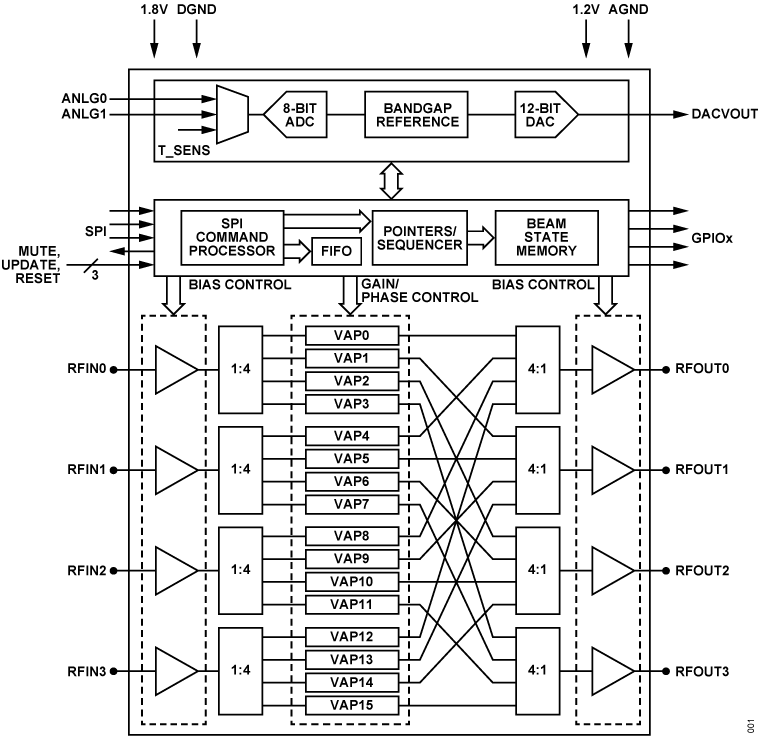
The ADAR3000/3001-EVALZ evaluation board evaluates the ADAR3000 and ADAR3001, 17.7 GHz to 21.2 GHz transmit or receive, 4-beam and 4-element Ka band beamforming core chips for phased arrays. Each of the 16 RF channels provides a 31.5 dB gain range in 0.5 dB steps and up to 54.5 ps of time delay in 0.865 ps steps, through variable amplitude and phase (VAP) blocks.
The device stores 256 beam positions in RAM, as 64 beamstates for each of its 4 beams, plus a FIFO of 16 beamstates per beam. A programmable sequencer steps through the stored beamstates, and update, reset and mute commands are applied per beam, over SPI or through dedicated pins. All registers are controlled through a 4-wire SPI, and four address pins allow up to 16 devices to share the same serial lines.
This reference design controls the evaluation board from an AMD Xilinx ZCU102, through an SDP-I-FMC interposer, running either Linux or no-OS. Under Linux the device is an IIO device. Under no-OS a basic example exercises and checks every driver feature, and an IIO example serves the device to libiio clients over the UART.
Features:
16 RF channels, as 4 beams of 4 elements
31.5 dB gain range in 0.5 dB steps per channel
Up to 54.5 ps of true time delay in 0.865 ps steps per channel
256 beam positions stored in RAM, and a 64 beam position FIFO
Programmable beamstate sequencer
Beamwise update, reset and mute commands, over SPI or pins
Programmable amplifier bias modes
On-chip 8-bit ADC with a temperature sensor
4-wire SPI, up to 16 devices on the same serial lines
Applications:
Geosynchronous high-throughput satellite (GEO HTS)
Low earth orbit (LEO) constellations
Mobile satellite terminals (land, air, and sea)
Terrestrial, airborne and satellite phased arrays
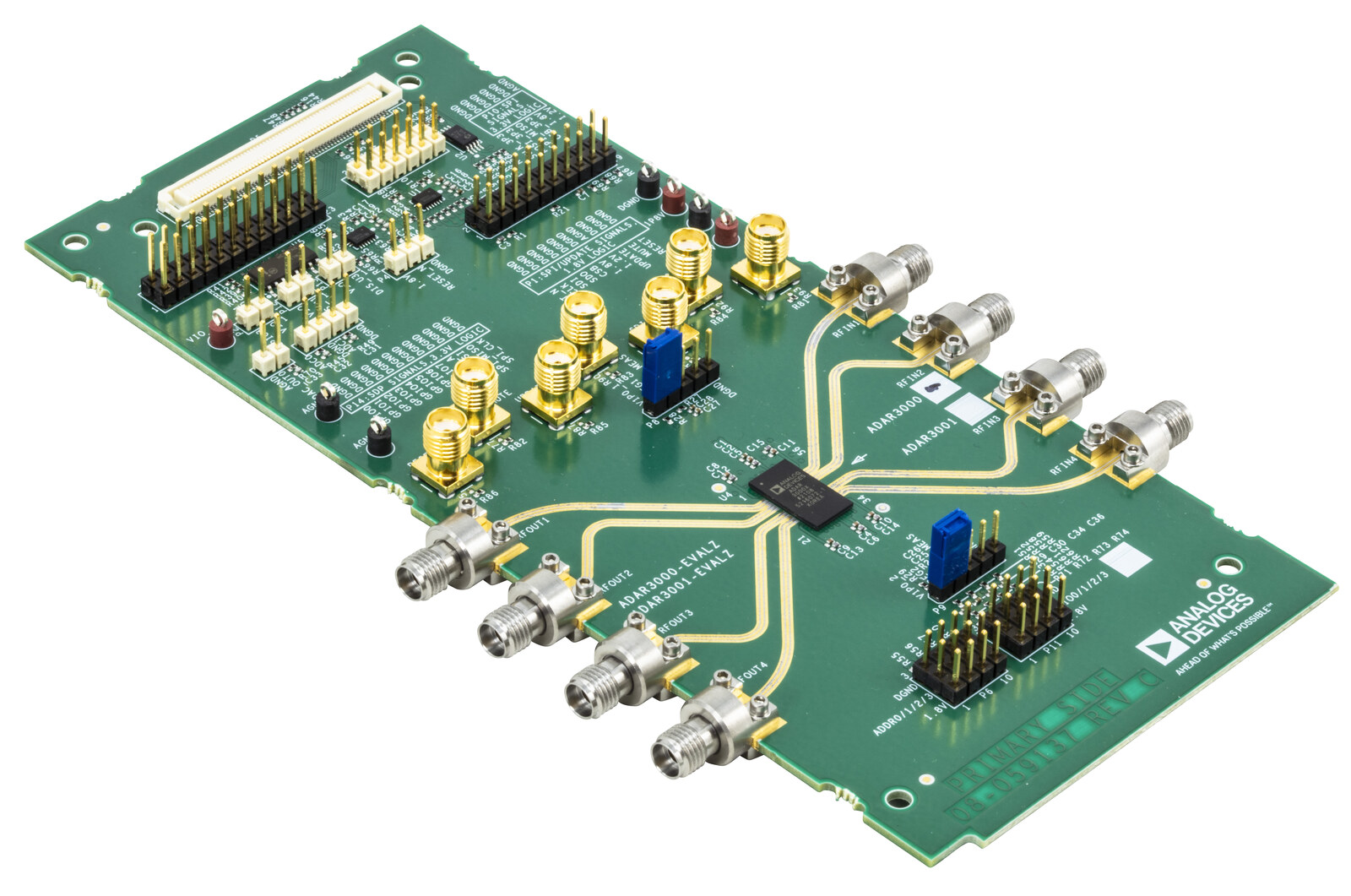
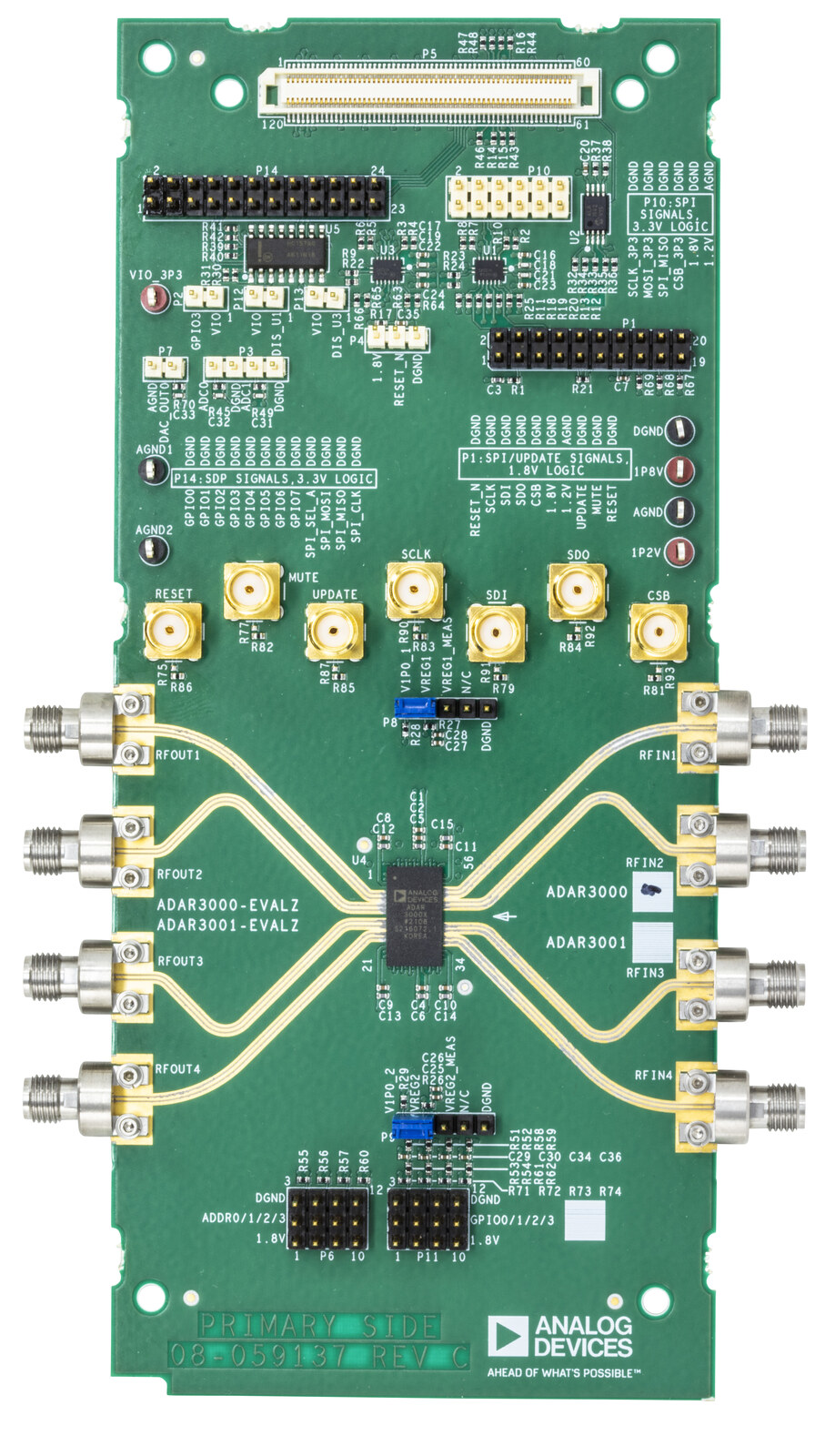
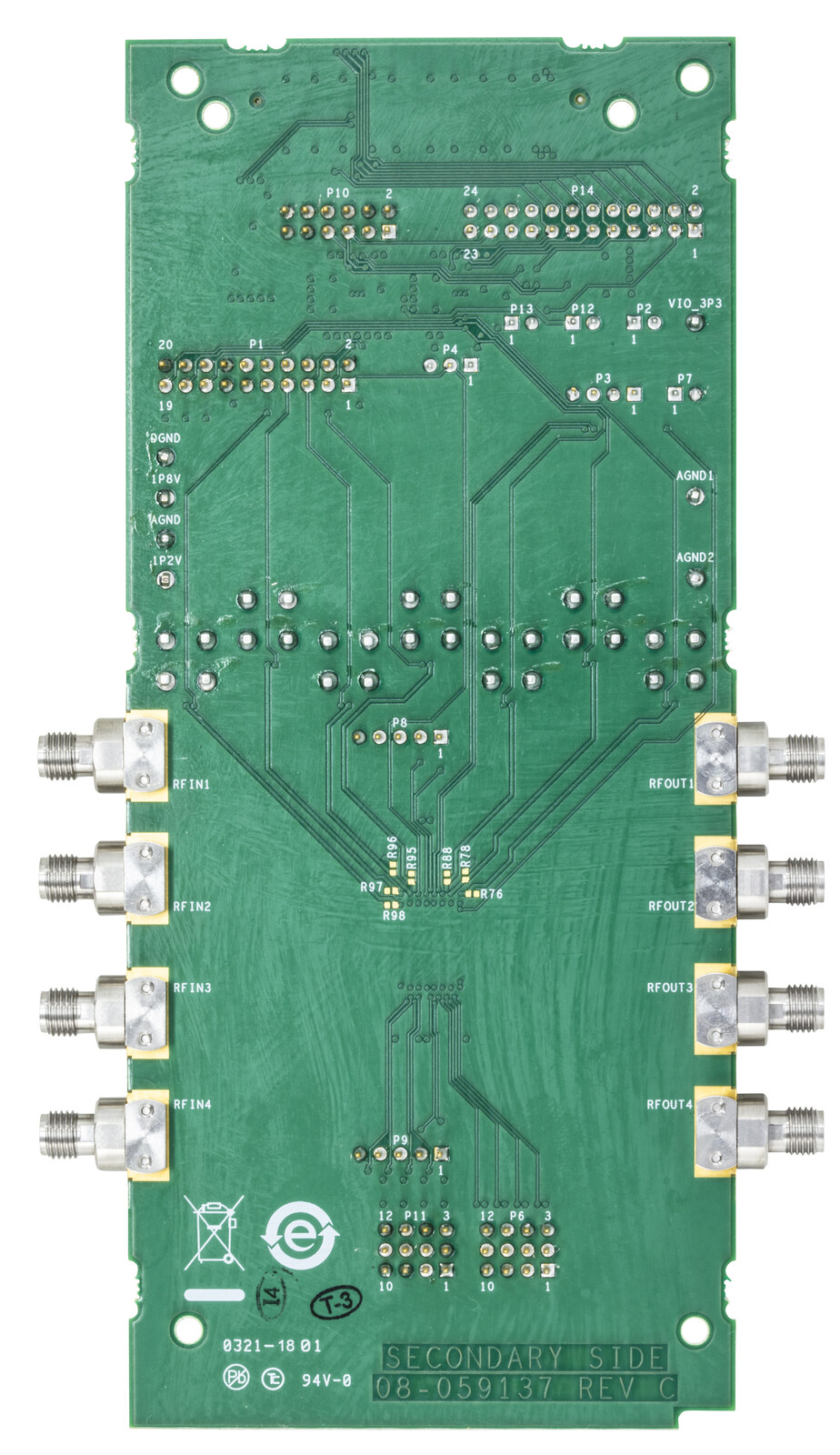
Recommendations
People who follow the flow that is outlined, have a much better experience with things. However, like many things, documentation is never as complete as it should be. If you have any questions, check the Help and Support section at the bottom of the page.
Table of contents
Using the evaluation board:
Prerequisites: what you need to get started
-
Using the ZCU102 with Linux or no-OS
User guide: hardware setup and board details
Design with the ADAR3000:
HDL reference design which you must use in your FPGA
Linux driver, its device tree binding and the ZCU102 device tree
no-OS driver, including its IIO interface
no-OS project, with the basic and IIO examples and the full IIO test procedure
Helpful documents
Block diagram
Warning
All the products described on this page include ESD (electrostatic discharge) sensitive devices. Electrostatic charges as high as 4000V readily accumulate on the human body or test equipment and can discharge without detection. Although the boards feature ESD protection circuitry, permanent damage may occur on devices subjected to high-energy electrostatic discharges. Therefore, proper ESD precautions are recommended to avoid performance degradation or loss of functionality. This includes removing static charge on external equipment, cables, or antennas before connecting to the device.
Help and support
For questions and more information, please visit the EngineerZone technical support community.