Engineering Intelligence is the capability to convert engineering intent into trustworthy, evidence-backed outcomes, while preserving what was learned so that each cycle improves the next. It represents a shift from using AI primarily to produce code toward using AI to support the broader work of engineering by connecting system reasoning, tool execution, validation, and technical judgment into a more coherent workflow.
There is a race underway to bring agentic AI into software engineering. Coding assistants are evolving into systems that can interpret intent, use tools, modify repositories, generate tests, and participate in increasingly complex development workflows. For embedded software, the most important measure of value is the quality of the engineering outcome. As David Perez argues in Beyond Code Completion: Benchmarking Agentic AI for Embedded Software, AI-assisted workflows should be judged by whether they help produce better embedded software. That judgment depends on the full embedded context in which the result must operate, from the target hardware and software environment to the constraints that shape runtime behavior. The more meaningful question is whether an AI-assisted workflow can carry that context through the work, execute the right steps, recover from safe failures, and leave behind evidence an engineer can trust.
That evidence-first perspective has implications beyond benchmarking. In Evidence-First Benchmark for Embedded AI Generation, David extends the argument by proposing that embedded AI should be evaluated through the full record of a pipeline run rather than through a single generated file. The full record of the work becomes the evidence: what the system was asked to do, how it acted, where it failed or recovered, what assumptions shaped the result, and why the final output should be trusted. This framing points toward a broader change in the software development lifecycle. When the reasoning, actions, failures, and evidence from each workflow are preserved, teams can reuse what they learn instead of reconstructing it during the next task. The SDLC then becomes more than a process for delivering software; it becomes a system that helps engineers make better-informed decisions with every iteration.
Opinions expressed in the content posted here are the personal opinions of the original authors, and do not necessarily reflect those of Analog Devices, Inc (ADI) or its subsidiaries. The content is provided for informational purposes only and is not meant to be an endorsement or representation by ADI or any other party. This site may also provide links or references to non-ADI sites and resources. ADI makes no representations, warranties, or other commitments whatsoever about any non-ADI sites or third-party resources that may be referenced, accessible from, or linked to this site.
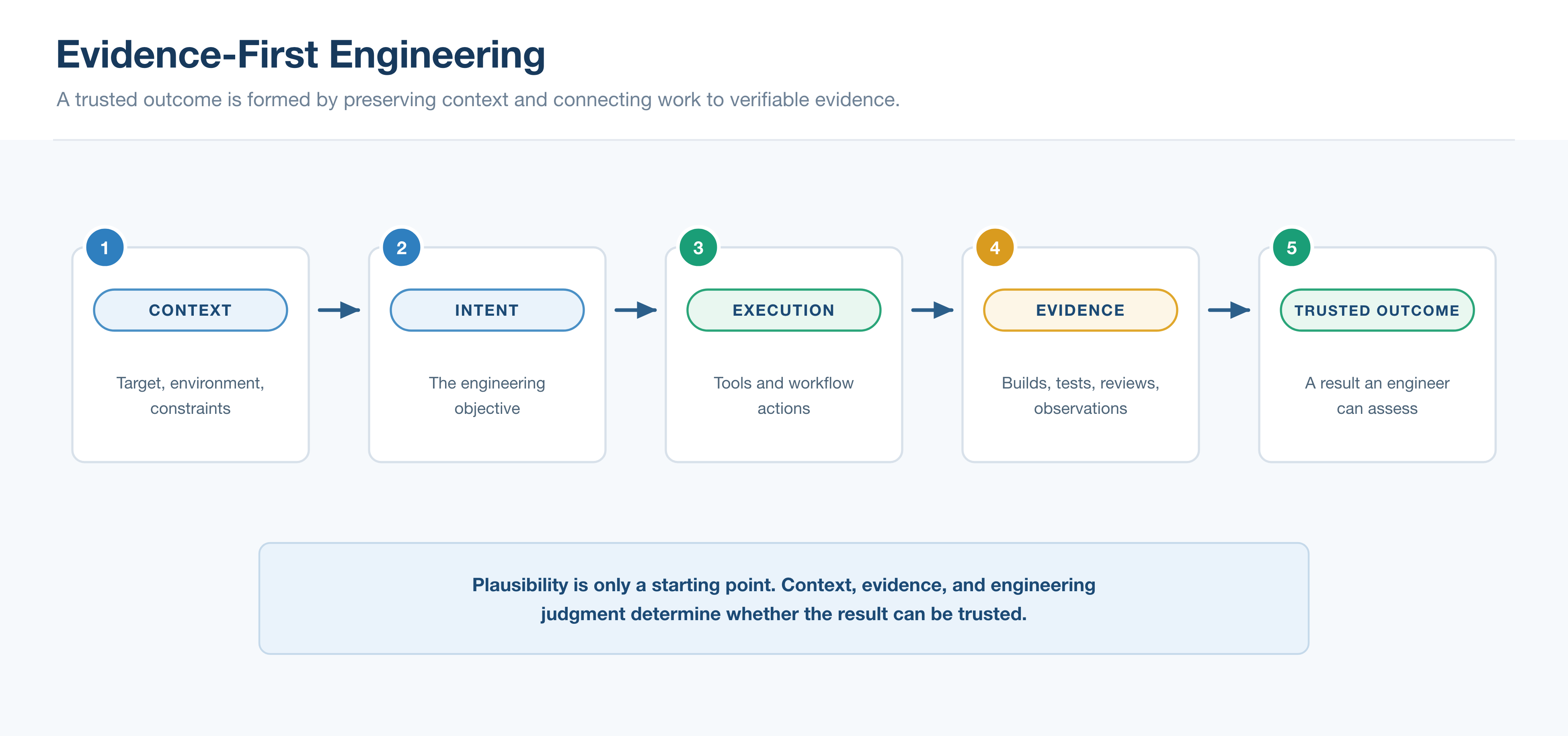
Figure 1. Evidence-first engineering connects context, intent, execution, and verifiable evidence to a trusted outcome.
The Limits of a Faster Pipeline
The traditional SDLC gives engineering work a reliable shape: it turns intent into architecture, architecture into implementation, implementation into evidence, and evidence into the next decision. That structure provides discipline, accountability, and repeatability. Its next evolution is to retain more of what engineers learn along the way, so teams do not have to reconstruct the reasoning behind previous decisions each time the work moves forward.
Modern engineering organizations have already automated much of the surrounding delivery machinery, from build and test infrastructure to security, compliance, deployment, and documentation workflows. Generative AI is now accelerating the creation of many engineering artifacts. The next opportunity is to make that speed more intelligent. As activity accelerates, teams also need a clearer view of the assumptions behind the work and whether faster execution is producing a more reliable result.
Transitioning from AI-assisted Coding to AI-assisted Engineering
Code generation is an important advance and an early signal of a deeper shift in software development. In embedded systems, useful software emerges only when implementation choices hold up against the practical constraints of the target device, including timing, memory, power, communication, and safety requirements. Correctness is therefore established through engineering evidence that connects source-level change to system-level behavior.
The central question is changing from artifact production to outcome formation. Instead of asking how much software AI can generate, the more useful question is how effectively an engineering system can turn intent into a trusted result. That shift changes the role of AI. A coding assistant helps produce artifacts. An agentic engineering system helps move an objective through the build, analysis, testing, and validation of work required to determine whether the result is trustworthy.
This shift also changes where engineers create the most value. As agents take on more routine implementation and workflow execution, engineers increasingly focus on the higher-leverage work of system design, security judgment, product trade-offs, and architectural accountability. Between human intent and automated execution, a new middle loop of supervision emerges: engineers decompose objectives, guide agents across tools and workflows, calibrate trust in their outputs, and determine whether the available evidence is sufficient. The engineer does not leave the loop; the engineer moves toward the parts of it where judgment, accountability, and system-level understanding matter most.
The distinction matters because the most valuable agentic systems will become better through feedback. Each build result, test failure, review finding, and hardware observation can make the next engineering cycle more informed than the last. Execution starts the workflow; feedback turns it into intelligence.
From Fragmented Workflows to Continuous Engineering
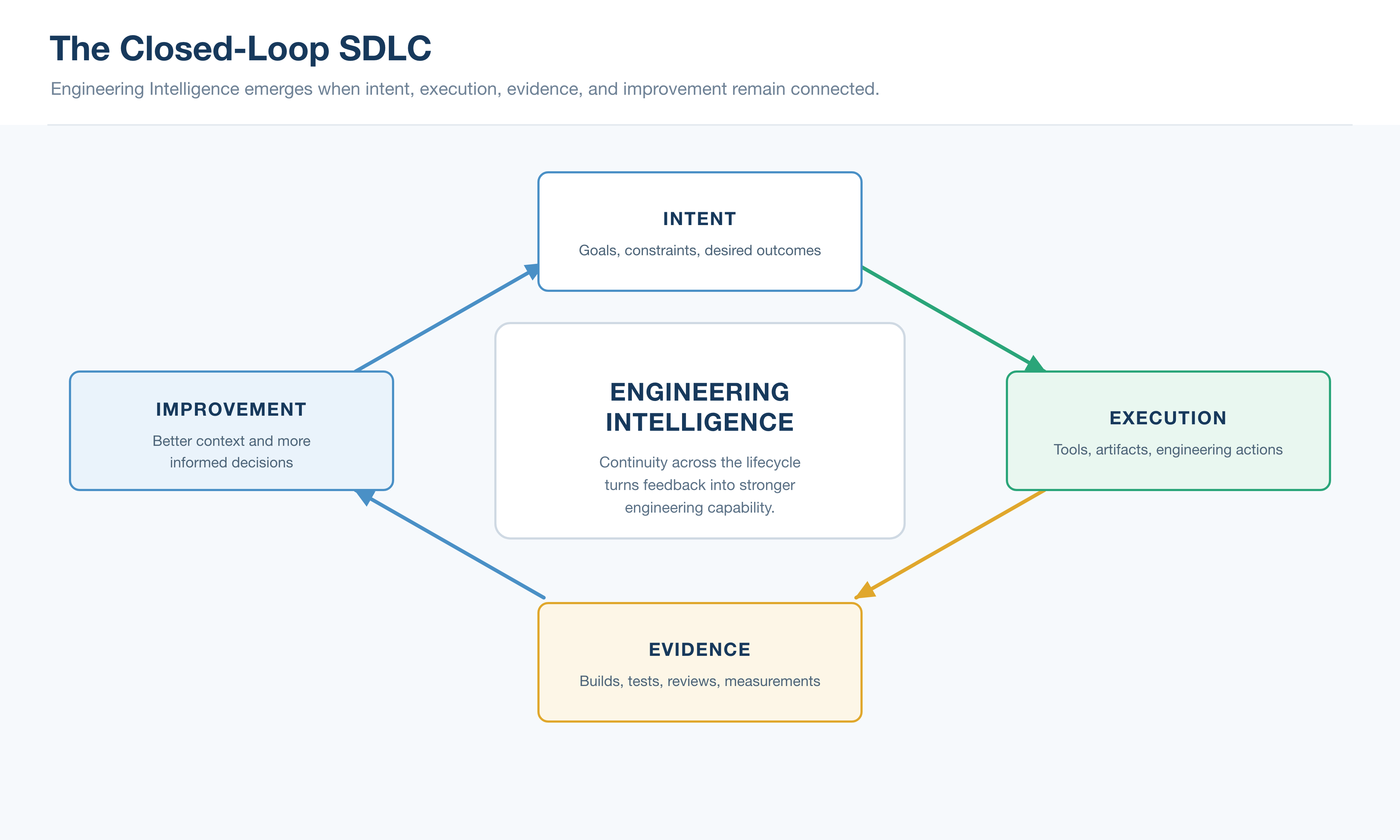
Engineering has always depended on feedback, but too much of that feedback remains trapped inside separate tools, artifacts, and handoffs. Agentic AI creates an opportunity to connect those traditionally separate activities into a continuous engineering system. Observations from one phase can inform and initiate actions in the next, while the context behind decisions is preserved across tools, teams, and iterations. The disruption is not simply a faster feedback loop, but continuity across the engineering lifecycle.
Figure 2. The closed-loop SDLC connects intent, execution, evidence, and improvement across the engineering lifecycle.
Engineering knowledge is often scattered across the many places where work happens, including code, tests, reviews, issues, documentation, and the experience engineers carry with them. Agentic systems create a way to carry more of that knowledge forward. A resolved failure can inform how similar failures are approached later, while a difficult validation can become reusable guidance for future work. Human judgment remains central, but engineers operate within a system that retains more of the reasoning and evidence produced along the way.
Every engineering task should produce two outcomes: a trusted result and an improvement in the organization’s ability to approach the next problem. This is where the economy becomes compelling. Automation saves effort during one execution, but an engineering system that improves through accumulated evidence can create value across many future executions.
Convergence as the New Measure of Velocity
Engineering metrics are beginning to evolve from measures of activity toward measures of learning and confidence. Code volume, ticket closure, test execution, and release frequency all describe important movement through the system, but the deeper question is whether that movement reduces uncertainty and improves the organization’s understanding of the product. A faster SDLC becomes more valuable when each cycle clarifies what should be built, how it behaves, and why the result can be trusted.
A more meaningful measure is how efficiently the engineering system converts uncertainty into validated understanding. Every project begins with unresolved questions about what should be built, how a change will affect the system, and whether the resulting behavior can be trusted. Software artifacts help answer those questions, but the real progress is the understanding they create.
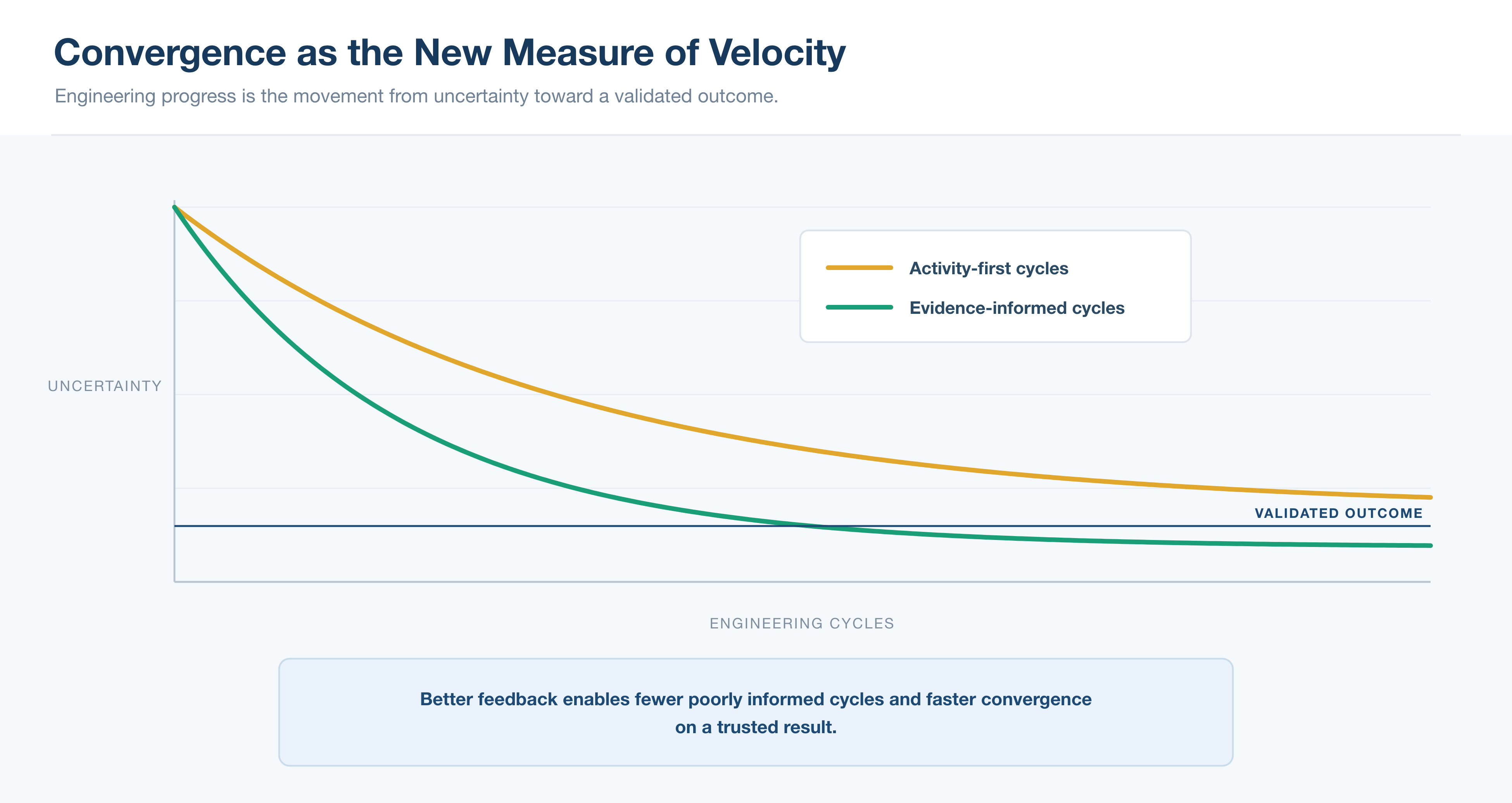
Engineering velocity is therefore the rate at which teams converge on a validated result. Agentic AI can improve that velocity by reducing poorly informed iterations and carrying what is learned into the next decision. The future SDLC will be differentiated not simply by how quickly it moves, but by how reliably it converges.
Figure 3. Evidence-informed cycles reduce uncertainty more efficiently and improve convergence on validated outcomes.
Why Embedded Systems Raise the Stakes
The need for evidence-driven agentic engineering becomes even more important when software interacts with the physical world. Embedded correctness depends on more than a clean build or plausible implementation; it depends on how the software behaves under the practical realities of the target system. This is why the evidence-first benchmark framing is so important. It encourages evaluation across the full engineering path, from build and hardware-context correctness through runtime behavior, maintainability, auditability, and efficiency. In these systems, the most valuable evidence frequently comes from the system itself.
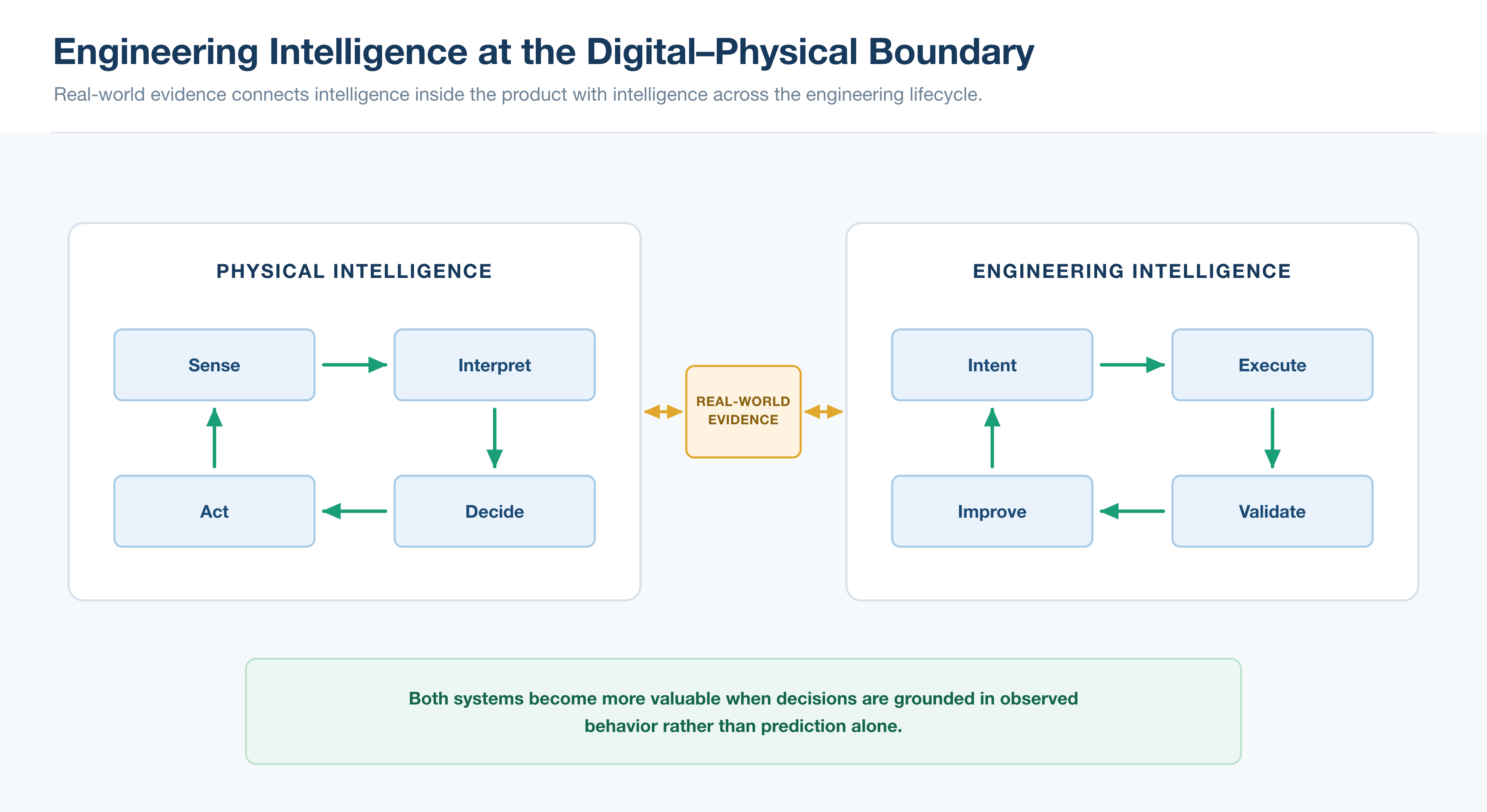
The future agentic SDLC extends naturally beyond source generation into the tools and observations engineers already use to understand system behavior. It connects intent with build systems, validation infrastructure, debug tools, hardware measurements, and the evidence needed to reason about real outcomes. This creates a natural connection with ADI’s vision for Physical Intelligence: just as Physical Intelligence connects sensing, interpretation, decision-making, and action inside the product, agentic engineering can create similar continuity in the way the product is developed.
Both depend on feedback. Both operate under uncertainty. Both become valuable when intelligence is grounded in what actually happened rather than what was merely predicted.
Consider an agent tasked with correcting an intermittent communications failure on an embedded platform. A successful build and passing test do not establish that the change is universally correct. The result applies to the specific conditions under which it was validated, including the board revision, toolchain version, firmware configuration, peripheral setup, and test environment. Trustworthy evidence must therefore preserve not only what passed, but also the configuration in which it passed. This allows engineers to understand where the conclusion applies, reproduce the result, and identify what still requires validation.
Figure 4. Real-world evidence connects Physical Intelligence in the product with Engineering Intelligence across the lifecycle.
ADI’s Opportunity
Analog Devices works at the boundary between the digital and physical worlds. Our engineers combine deep hardware and software expertise with signal-chain knowledge and application-level understanding. That breadth gives ADI a distinctive opportunity in the evolution of agentic engineering. We at ADI are best positioned to explore how trusted tools, relevant context, human judgment, and real-world evidence work together across the lifecycle to create a more capable engineering system.
That opportunity depends on dependable interfaces, observable workflows, reproducible results, and evidence that engineers can inspect. It also depends on a responsible relationship between autonomy and trust. Trust grows when a system demonstrates reliable outcomes under appropriate oversight, with familiar and well-bounded tasks supporting higher levels of automation and novel or consequential decisions receiving greater scrutiny.
The objective is an SDLC that gives engineers more leverage. By reducing the time spent reconstructing context and repeating mechanical work, agentic engineering creates more room for judgment, creativity, and systems thinking where those qualities matter most.
From Software Delivery to Engineering Intelligence
The first wave of AI in software development made artifact production faster. The next wave will make engineering work more connected to evidence and outcomes. Its defining feature will be the ability of the broader engineering system to preserve intent, use feedback, reduce uncertainty, and improve the quality of subsequent decisions.
This is the foundation of Engineering Intelligence: an SDLC that does not simply move software through a process, but preserves context, connects decisions to evidence, and turns each cycle of work into durable engineering capability.
The organizations that lead in this new era will be the ones that reach trusted outcomes more effectively. They will preserve engineering context, connect software decisions to real-world evidence, learn from failures, and move faster because each cycle leaves them better prepared for the next.
The future SDLC will not merely deliver software. It will build engineering capability, and that capability will compound.