blog
July 22, 2026
Beyond Code Completion: Benchmarking Agentic AI for Embedded Software
What we measure is what we'll trust

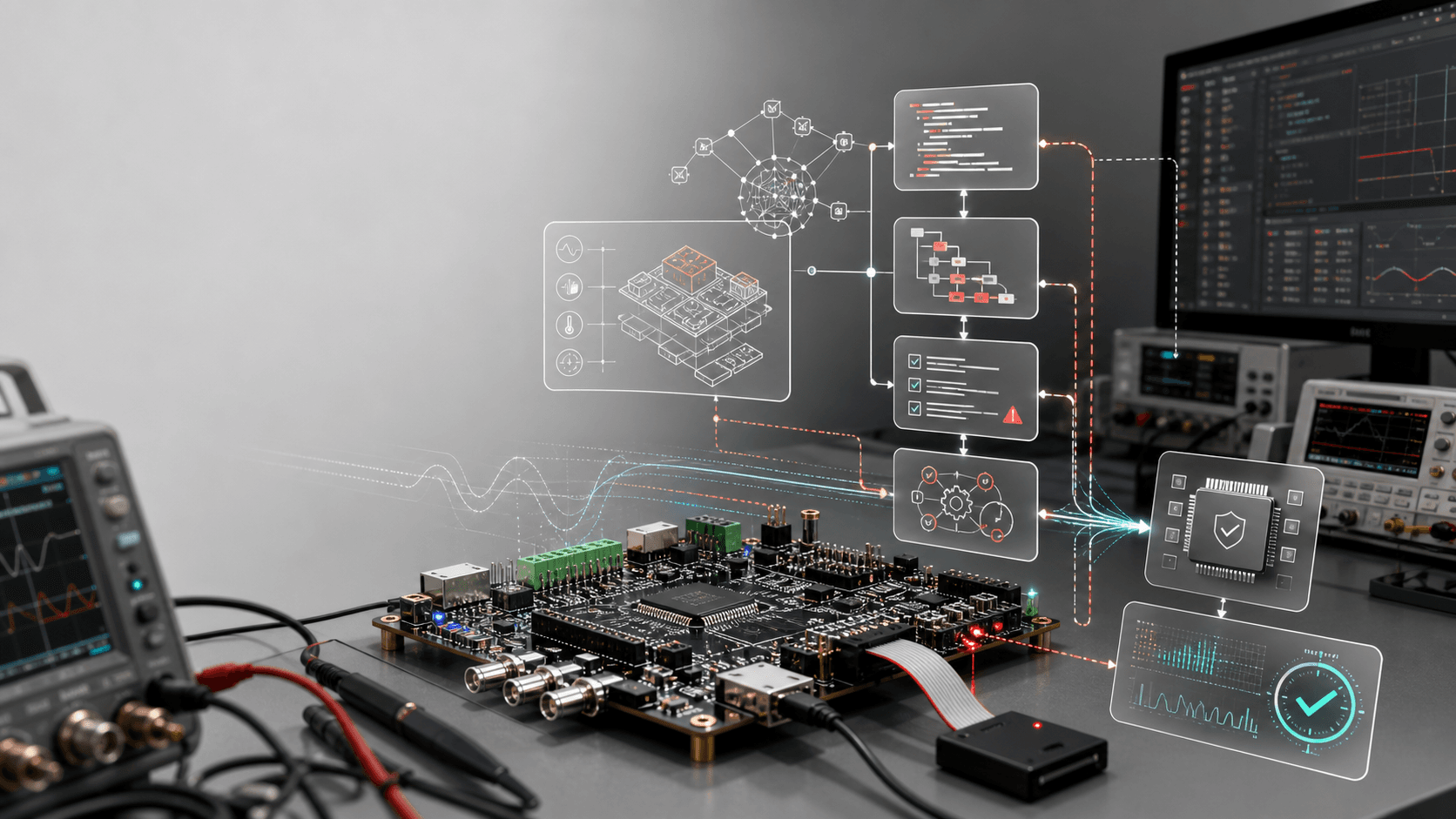
There is a race underway in the Embedded Software Industry. Startups, IDE vendors, and platform teams are rushing to ship agentic code generation for embedded software, most of them wrapping up raw Claude or Copilot around a terminal and calling it a productivity breakthrough. Before we declare victory, we need to ask the question no one is asking: are we actually generating better embedded software?
Embedded software teams have always used automation: code generators, board support packages, configuration tools, static analyzers, CI systems, and hardware validation loops. Agentic AI does not replace that discipline. Used well, it moves the automation boundary from "write this function" toward "help me complete and validate this workflow."
For embedded developers this is a meaningful distinction. A generated C file is not useful by itself if it does not match the selected board and the context it needs to operate in (RTOS configuration, DeviceTree, SDK, compiler, memory map, etc). The interesting question is whether an AI-assisted workflow can understand the active hardware context, generate source and build artifacts, run the toolchain, classify failures, repair what is safe to repair, and leave behind evidence an engineer can trust.
That is the direction behind recent research work on multi-agent Zephyr software generation and the broader CodeFusion Studio ecosystem. It also raises a harder question: how should we benchmark AI-generated embedded software?
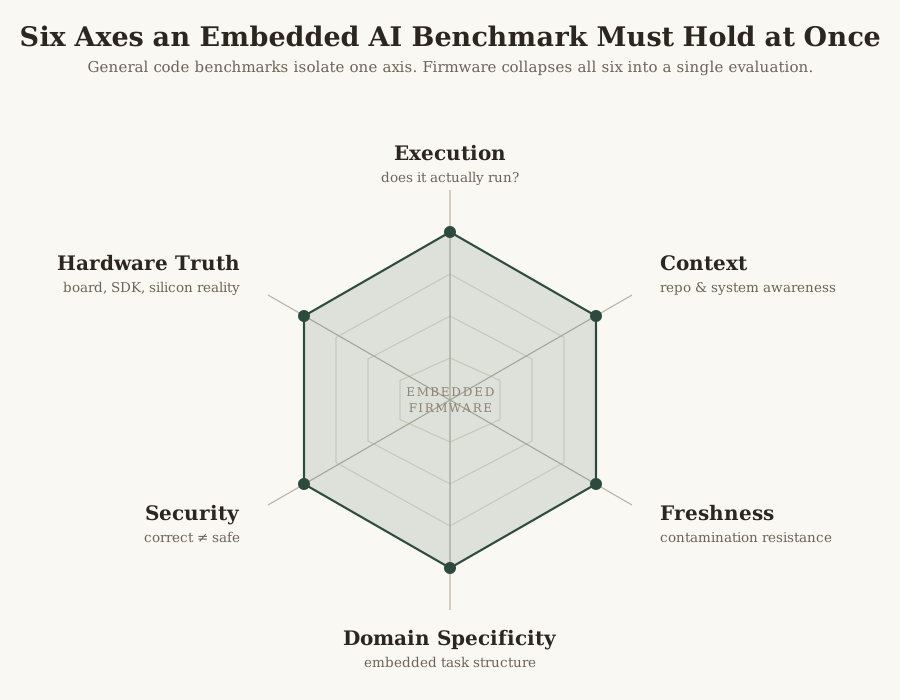
The answer cannot be a single pass/fail unit test. Embedded development is a systems problem and consequently embedded AI benchmarks need systems evidence.
A Short History of AI Code Generation Evaluation
Early code-generation benchmarks treated synthesis as a compact programming task. HumanEval, introduced with OpenAI Codex, asked models to generate Python functions from docstrings and measured whether those functions passed tests. It was influential because it evaluated executable behavior instead of text similarity.
EvalPlus then showed why small test sets are not enough. By expanding test coverage, it exposed solutions that passed weaker tests but failed stronger ones. That lesson is especially relevant to firmware, where overflow, interrupt context, timing assumptions, etc are often the real product risks.
LiveCodeBench added another lesson: benchmarks need to move. Static public datasets become easier to memorize or indirectly train on. LiveCodeBench continuously incorporates newer problems and evaluates capabilities such as execution, self-repair, and test-output prediction. Embedded benchmarks should follow that direction with private, rotating, versioned scenarios.
Tags
Comments
Join the conversation at EngineerZone
Opinions expressed in the content posted here are the personal opinions of the original authors, and do not necessarily reflect those of Analog Devices, Inc (ADI) or its subsidiaries. The content is provided for informational purposes only and is not meant to be an endorsement or representation by ADI or any other party. This site may also provide links or references to non-ADI sites and resources. ADI makes no representations, warranties, or other commitments whatsoever about any non-ADI sites or third-party resources that may be referenced, accessible from, or linked to this site.