About Analog Devices

  • Analog.com
  • EngineerZone
  • Signals +
  • Analog Dialogue

Join MyAnalog for information about ADI products, design tools and training

  • Linkedin
  • Instagram
  • Youtube
  • Facebook
  • Twitter

Find Help

  • Support
  • EngineerZone
  • Resources
  • Wiki

Connect

Contribute with knowledge that powers the ADI Developer

  • Legal and Risk
  • Accessibility
  • Privacy Policy
  • Privacy Settings
  • Cookie Settings
  • 沪ICP备09046653号-1

©2026 Analog Devices, Inc. All Rights Reserved

  • Home
  • /
  • Blogs
  • /
  • ADI Leads with Open-Source Drivers

blog

October 23, 2026

ADI Leads with Open-Source Drivers

Open-source drivers and long-term software support to help build reliable, future-proof products around ADI hardware.

Ala Ouertani avatar
Ala Ouertani
Product Marketing, Software & Digital Platforms Group
Share
ADI Leads with Open-Source Drivers

You have picked a component, built your first prototype, and the driver worked. But what happens six months from now when your OS updates, your compute platform changes, or a new security requirement lands on your desk?

As designs move from evaluation to deployment, you have to navigate changing operating systems, new compute platforms, security requirements, software updates, and evolving application needs. A driver may help start the first prototype, but its long-term value depends on whether it can keep supporting your product as the surrounding ecosystem changes.

That is why we invest in open-source drivers, upstream development, community collaboration, and the infrastructure needed to maintain software over time. The goal is not simply to make software available, but to give you a reliable foundation on which you can build, differentiate, and evolve your products.

A Software Foundation Built at Scale

If you are working across multiple product lines, you already know the challenge: different operating systems, different compute platforms, different application environments — and each one needs reliable software support.

Supporting a handful of components is one thing. We enable thousands of signal-chain products across all of those environments, and that requires a broader and more consistent software foundation.

Our Software portfolio Includes:

1,500+ Linux Device DriversProduction-ready drivers for ADI hardware on Linux platforms.
Browse our Open-Source Repository
600+ No-OS DriversLightweight drivers for bare-metal embedded applications without an operating system.
Browse our Open-Source Repository
20+ Zephyr DriversDrivers for Zephyr RTOS, focused on connected embedded, sensing, and power-monitoring applications.
Browse our Open-Source Repository
80+ FPGA IP CoresPre-built IP cores for integrating ADI devices on FPGA platforms.
Browse IP Cores

The value isn't simply the number of drivers. It's the ability to support developers across a broad range of technologies using a consistent software enablement approach.
Explore our Drivers Catalog

Scale also comes from building on common software foundations.

Comments

Join the conversation at EngineerZone

Opinions expressed in the content posted here are the personal opinions of the original authors, and do not necessarily reflect those of Analog Devices, Inc (ADI) or its subsidiaries. The content is provided for informational purposes only and is not meant to be an endorsement or representation by ADI or any other party. This site may also provide links or references to non-ADI sites and resources. ADI makes no representations, warranties, or other commitments whatsoever about any non-ADI sites or third-party resources that may be referenced, accessible from, or linked to this site.
The Industrial I/O (IIO) subsystem provides a standardized Linux kernel framework for devices such as data converters and sensors, while libiio provides a common interface for accessing IIO devices across platforms. By contributing to these open-source technologies, ADI helps customers build around established interfaces instead of device-specific implementations, while benefiting from an ecosystem that can continue to evolve over time.

Building for the Long-term

Developing a prototype is one milestone. Maintaining and evolving a product over many years is often the bigger challenge. As platforms, operating systems, and application requirements change, the software behind your product needs to evolve with them.

Open-source development and upstream collaboration help keep that software connected to actively maintained ecosystems rather than isolated in private code branches. Customers can access and understand the software, adapt it to their needs, and benefit from improvements contributed by ADI and the broader community.

For you, this means:

  • Less time maintaining drivers and more time developing your application
  • Easier adoption of future software and platform updates
  • Access to ongoing fixes, security updates, and community improvements
  • Software that can evolve alongside your product requirements
  • Greater reuse of software investments across product generations

Commitment Beyond Release

You have shipped your product. But your OS vendor releases a new version, a security vulnerability is disclosed, or your customer needs you to support a new platform. Now what?

Releasing software is only the beginning. That is why we continue to invest not only in developing software, but also in maintaining, validating, and improving it over time. Through automated CI/CD workflows, continuous testing, and peer review processes, we can validate software changes earlier, helping improve quality and reliability across a broad portfolio of products.

AI-Assisted Reviews for Speed and Quality

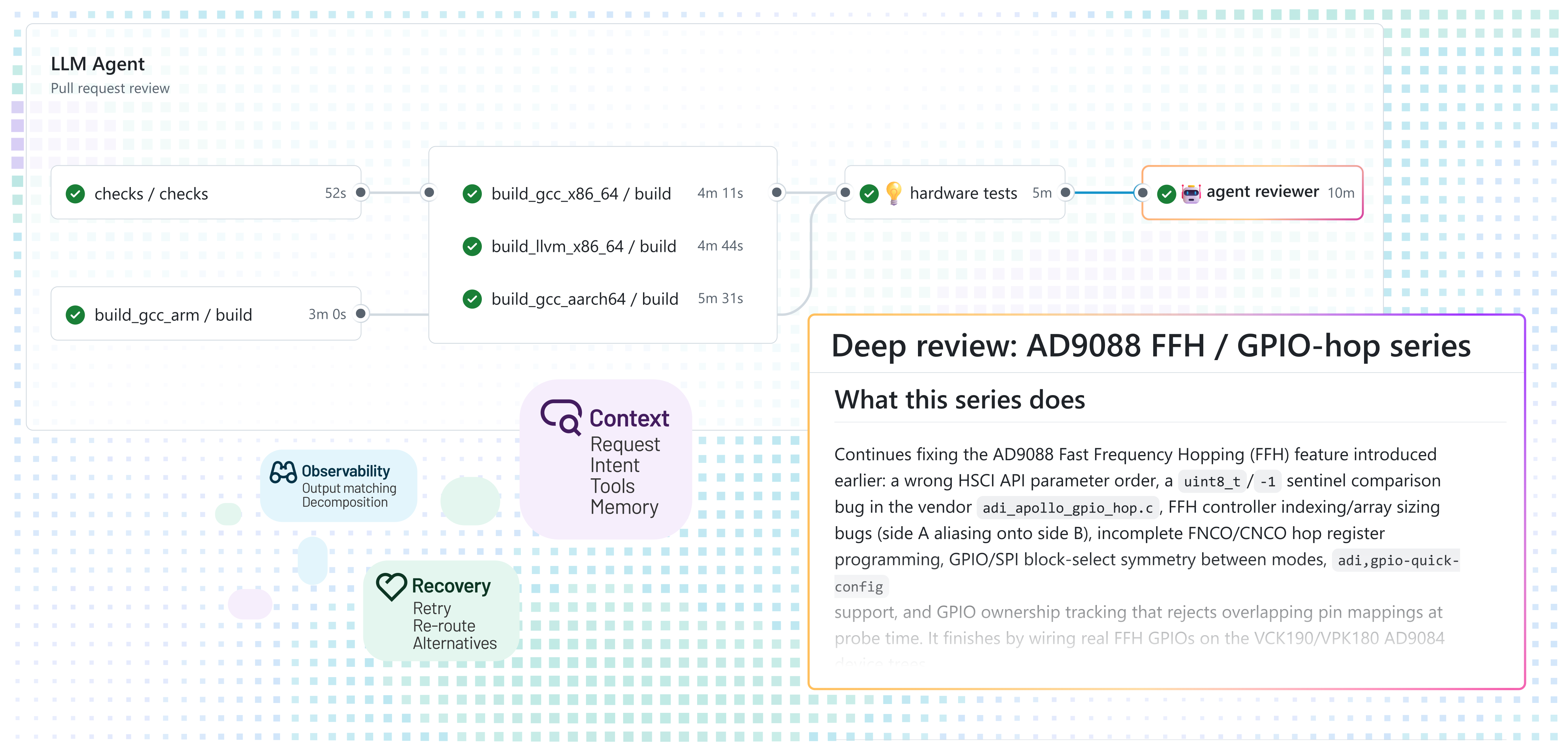
We are also exploring new ways to enhance software development through AI-assisted tools. Initiatives such as the AI-powered PR Review Agent help provide earlier feedback during code reviews, supporting developers and maintainers in delivering higher-quality software more efficiently.

AI-assisted PR review integrated into the CI/CD workflow for faster feedback and stronger software quality.

For you, these investments translate into:

  • More reliable software releases that do not surprise you after integration
  • Faster access to improvements and fixes when you need them
  • Less time spent on integration and maintenance work that does not differentiate your product
  • Greater confidence that your software foundation will be support

Read more: How ADI is using AI to improve open-source software reviews with the AI-Powered PR Review Agent

More Than Software

At ADI, software enablement is about more than making devices work. It's about helping customers move faster, reduce development effort, and build products that can evolve over time.
Through industry-leading investments in drivers, open-source software, ecosystem collaboration, and continuous innovation, ADI continues to expand its software enablement portfolio and strengthen the foundations on which customers build their solutions.
Because software enablement is not an add-on to the hardware. It's an essential part of the customer experience.
To explore more of ADI's software enablement portfolio, open-source projects, documentation, and developer resources, visit our GitHub Documentation page.