blog
March 10, 2026
Scalable Phased Array & Adaptive RF Systems Enabled by ADI DataX™
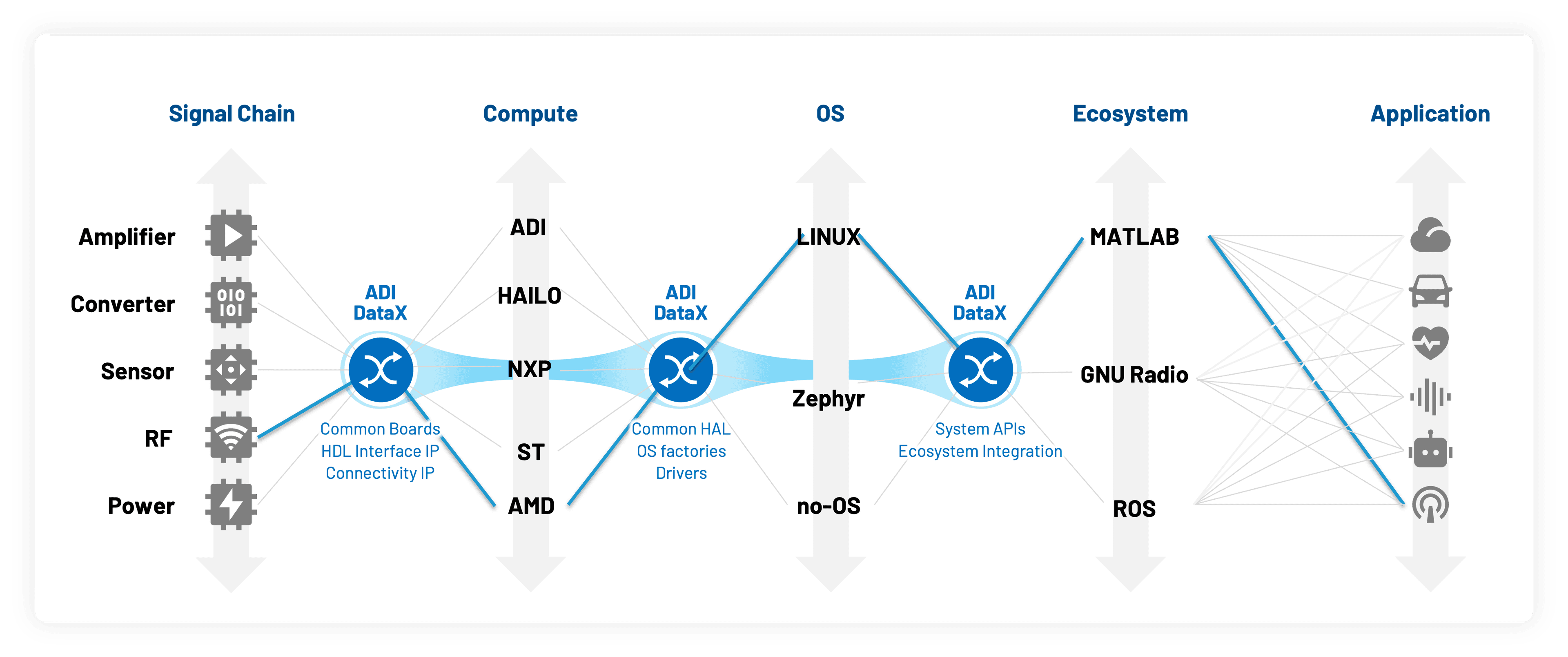
One RF application. Multiple platforms. Same development experience.


When developing advanced Software-Defined Radio (SDR) and phased array systems, the real challenge is rarely the Radio Frequency (RF) algorithm itself. The challenge is everything around it: platform differences, software stacks, data interfaces, ecosystems, and toolchain friction.
This demo was created to show something very specific:
With ADI DataX™, an application can be rapidly prototyped and scaled on the preferred hardware and compute platforms, due to the highly re-usable and modular software infrastructure building blocks.
Using a monopulse tracking radar application as an example, we demonstrate how ADI DataX™ enables a workflow where platform choice becomes an implementation detail, not a constraint.
System Overview:
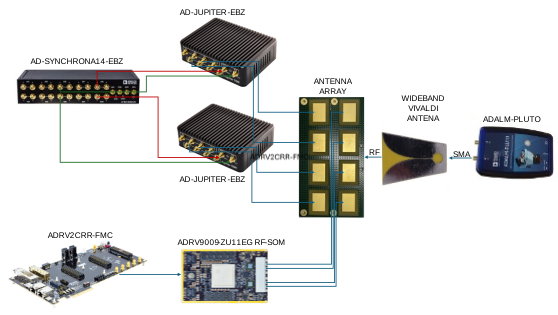
Transmitter system:
An ADALM‑PLUTO is used to generate and transmit the RF signal through a wideband Vivaldi antenna.
The transmitter side is intentionally simple:
- It provides a known, repeatable RF source
- No custom waveform or firmware development is required
- The emphasis remains on receiver side scalability and software reuse
Receiver systems: Same application, Different environments
Two different SDR platforms are used to run the same monopulse tracking concept, each paired with a different software ecosystem.
Receiver System 1: Jupiter SDR Platform
The first receiver system is based on the AD-JUPITER-EBZ, a versatile software defined radio platform built around:
- The ADRV9002 RF transceiver.
- A Xilinx Zynq UltraScale+ MPSoC compute platform.
Receiver System 2: RF‑SOM Platform with MATLAB
The second receiver system is based on the ADRV9009-ZU11EG RF-SOM, a highly integrated RF SystemOnModule built around:
- The ADRV9009 RF transceiver
- A Xilinx Zynq UltraScale+ MPSoC compute platform
The RF‑SOM is designed as a compact platform for .In this demo, it is mounted on the carrier board, which provides the required interfaces and power.On this platform, the monopulse tracking application is implemented using , allowing algorithm development and validation in a familiar, high‑level environment.
Tags
Comments
Join the conversation at EngineerZone
Opinions expressed in the content posted here are the personal opinions of the original authors, and do not necessarily reflect those of Analog Devices, Inc (ADI) or its subsidiaries. The content is provided for informational purposes only and is not meant to be an endorsement or representation by ADI or any other party. This site may also provide links or references to non-ADI sites and resources. ADI makes no representations, warranties, or other commitments whatsoever about any non-ADI sites or third-party resources that may be referenced, accessible from, or linked to this site.