blog
October 26, 2026
GMSL meets V4L2: Now in mainline Linux
GMSL: Connecting the Next Generation of Vision Systems

Gigabit Multimedia Serial Link (GMSL™) technology from Analog Devices provides high-bandwidth connectivity for camera and video systems. But connectivity is only part of building a complete vision system. Developers also need to connect cameras to their compute platform, integrate them with the operating system, and ultimately get video into their application.
With GMSL support now in mainline Linux through the V4L2 video subsystem, that path becomes more aligned with the standard Linux video ecosystem.
Instead of treating GMSL as a separate software environment, developers can build around familiar Linux interfaces and open-source software.
GMSL Joins the V4L2 Video Framework
V4L2, or Video4Linux2, provides the Linux kernel API for video devices, covering capabilities such as video input and output, device controls, formats, and camera controls.
The Linux Video Foundation
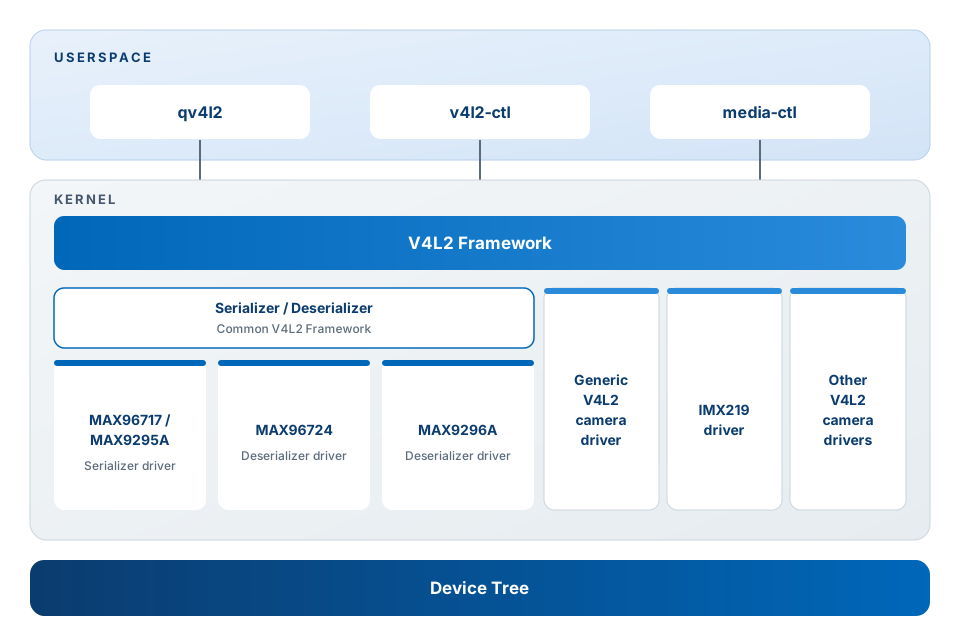
For an application developer, the value of V4L2 is that it provides a defined interface between Linux applications and the underlying video hardware. Applications can interact with video devices through the V4L2 API while the kernel-side drivers handle the hardware-specific implementation. This API covers device capabilities, video inputs and outputs, camera controls, formats, and data streams.
That distinction becomes important with GMSL. A camera system can contain an image sensor, serializer, deserializer, compute platform, and application, but the application should not need its own interface for every layer of that chain.
This is where ADI's contribution fits: GMSL technology and SerDes drivers are integrated with V4L2 so that GMSL connectivity becomes part of the Linux video architecture rather than a separate software path.
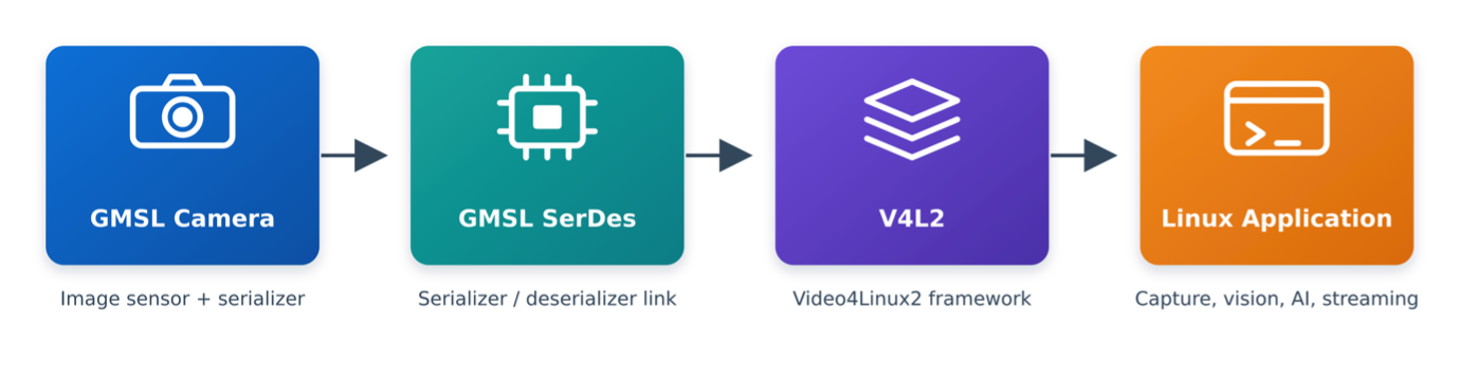
The goal is simple: make the SerDes increasingly transparent to the application developer.
Once the hardware is connected and configured, developers can focus more on the camera and application layer rather than building a separate software stack around the connectivity itself.
Why It Matters
Mainlining GMSL is more than moving driver code into the Linux kernel. For developers building products around Linux, it provides a stronger software foundation.
Making GMSL Easier to Integrate
With GMSL integrated into V4L2, developers can work within the Linux video framework rather than introducing a separate GMSL-specific video interface. ADI is also the maintainer of the Linux SerDes Common V4L2 framework.
Comments
Join the conversation at EngineerZone
Opinions expressed in the content posted here are the personal opinions of the original authors, and do not necessarily reflect those of Analog Devices, Inc (ADI) or its subsidiaries. The content is provided for informational purposes only and is not meant to be an endorsement or representation by ADI or any other party. This site may also provide links or references to non-ADI sites and resources. ADI makes no representations, warranties, or other commitments whatsoever about any non-ADI sites or third-party resources that may be referenced, accessible from, or linked to this site.