blog
February 18, 2026
CodeFusion Studio 2.0 & Open Source: A Deep Dive into the Architecture and How the Community Can Contribute
Creating ecosystems that scale, adapt, and invite collaboration

Introduction: Why Architecture Matters
The future of embedded development isn’t just about faster compilers or prettier GUI’s it’s about ecosystems that scale, adapt, and invite collaboration. CodeFusion Studio™ 2.0 was built with this principle at its core: an IDE that unifies embedded and AI workflows while remaining open and extensible. In this post, we’ll peel back the layers of its architecture and explore how developers, partners, and the open-source community can extend and innovate on top of it.
The Foundation: Zephyr-First, CLI and JSON Everywhere
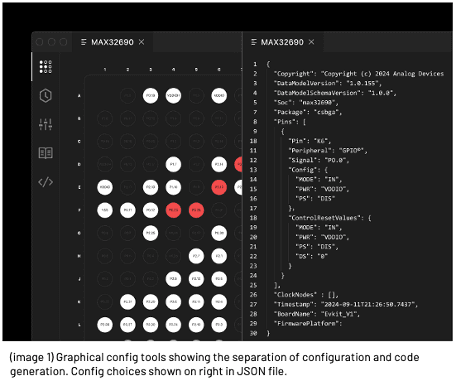
At the heart of CFS 2.0 lies a Zephyr-first integration layer, ensuring alignment with industry-standard APIs and drivers. Every configuration from peripheral mapping to TrustZone® partitions are captured in portable JSON configuration files. Why does this matter? Because JSON makes workflows reproducible, version-controlled, and CI/CD-ready. It’s the single source of truth that enables automation and collaboration across teams.
Modularity by Design
CodeFusion Studio Architecture is modular by design. CFS 2.0 introduced a major architectural overhaul focused on portability, modularity, and scalability:
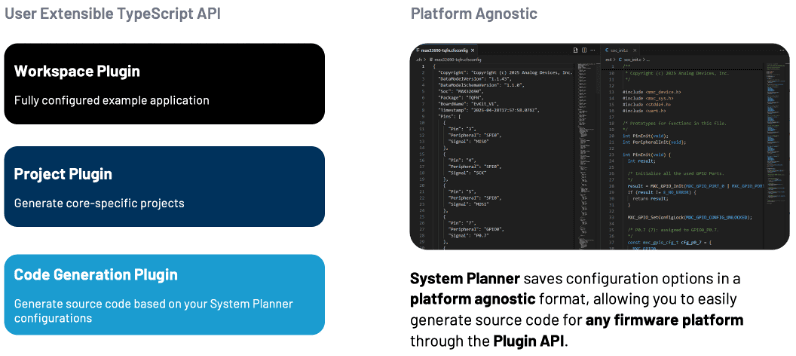
· UI Layer: Built as a Visual Studio Code extension using TypeScript for flexibility and modern UX.
· Plugin Architecture: Developers can create context-aware plugins for custom RTOS, SDKs, or workflows. The plugin system cleanly separates configuration from code generation, allowing customization while ensuring seamless integration.
· Command-Line Interface: Full-featured CLI (cfsutil) provides parity with GUI workflows for automation and CI/CD integration.
This modular approach means you're not locked into a monolithic IDE - you're part of an evolving ecosystem built on open-source principles.
AI Workflows: Flexible and Reproducible
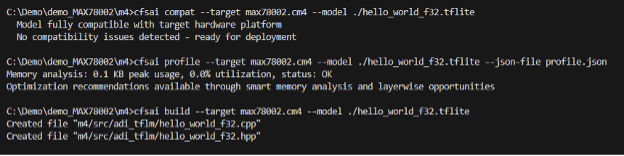
AI is a first-class citizen in CFS 2.0. The system supports multiple backend architectures to isolate dependencies and ensure reproducibility across Linux, Windows, and macOS. TensorFlow Lite models can be imported and deployed through streamlined pipelines, with containerized backends available for specific accelerators like the processor.
Tags
Comments
Join the conversation at EngineerZone
Opinions expressed in the content posted here are the personal opinions of the original authors, and do not necessarily reflect those of Analog Devices, Inc (ADI) or its subsidiaries. The content is provided for informational purposes only and is not meant to be an endorsement or representation by ADI or any other party. This site may also provide links or references to non-ADI sites and resources. ADI makes no representations, warranties, or other commitments whatsoever about any non-ADI sites or third-party resources that may be referenced, accessible from, or linked to this site.