From Slip Detection to Industrial Dexterity Benchmarks: What We’re Bringing to NEMS 2026
Join Analog Devices, Inc. at New England Manipulation Symposium (NEMS) 2026 (June 16–17 at UMass Amherst). Visit our booth to learn about our robotic dexterity research.
June 16, 2026 - June 17, 2026
UMass Amherst Computer Sciences Laboratories (CSL) Building, room E144, 130 Governors Drive, Amherst, MA 01003.
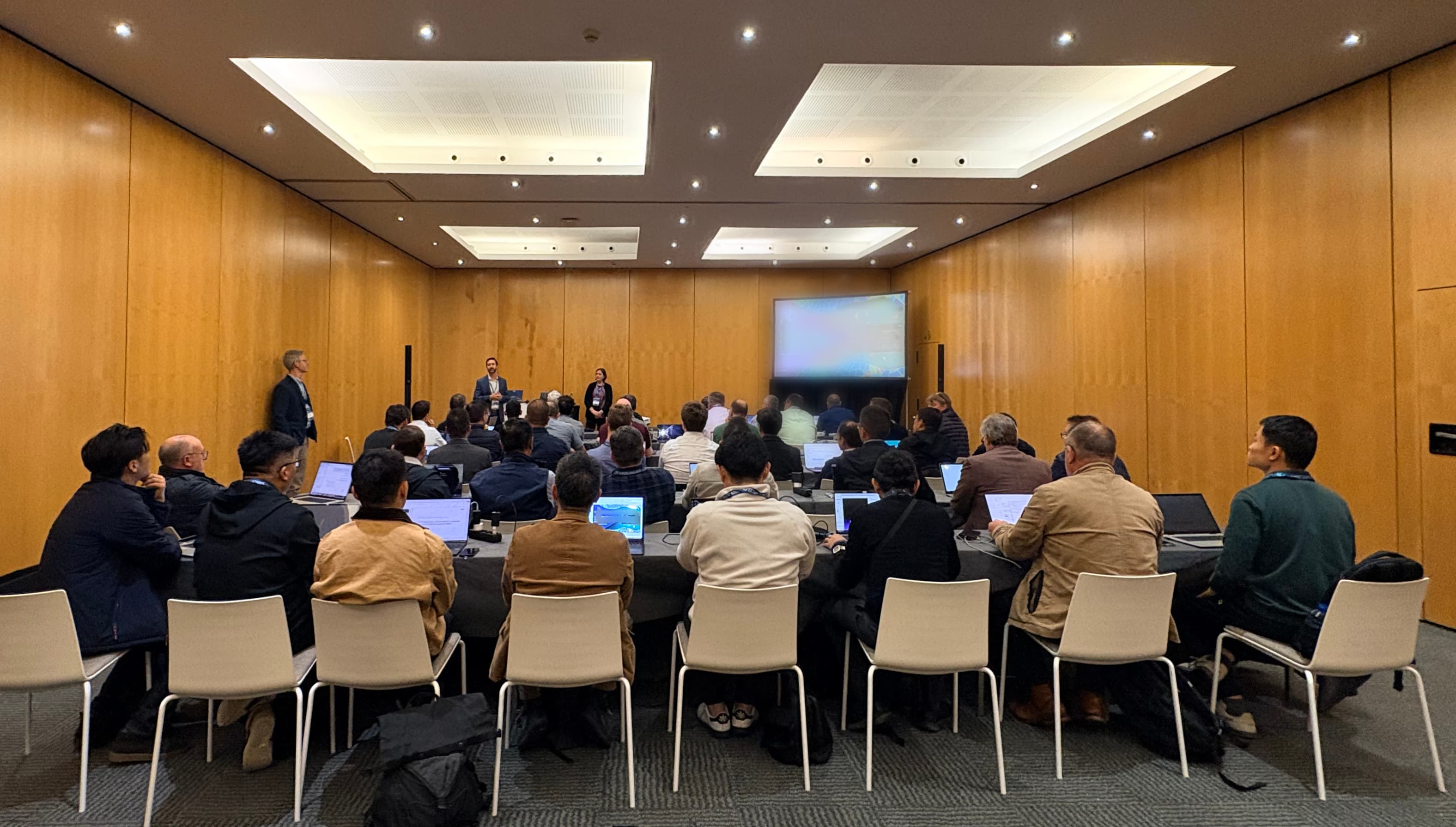
Next week, members of the Analog Devices, Inc. (ADI) robotics research team will be at the New England Manipulation Symposium (NEMS) 2026, held at University of Massachusetts Amherst on June 16–17, 2026. The event brings together researchers and builders working on robotic manipulation, from mechanisms and control to learning, perception, and planning. This year’s program also puts special focus on open-source work and benchmarking, which matches how we think progress should be measured and shared.
We’re attending for a simple reason. Many high-value industrial tasks still depend on human hands, even when robots are available. Cable work in data centers, hidden connector insertion, cable harness routing, and small-part assembly are great examples. These tasks mix tight spaces, contact-rich motion, and small errors that compound fast. To move from demos to repeatable deployments, the field needs two things at once: better sensing and better ways to compare end-to-end systems under the same rules.
At NEMS 2026, ADI’s team is presenting a new benchmark and two papers that focus on those two needs.
Industrial dexterity benchmarking in practice
Before diving into our two talks, ADI’s booth will feature a new Industrial Dexterity Benchmark developed by our robotics teams. Our goal was to connect unsolved customer industry dexterity challenges with repeatable tests, clear metrics, and shared artifacts.
We’ll be showing three test bench designs:
- Data center cable management, including cable extraction, cleaning, and insertion
- Cable harness routing with hidden connectors, occlusion, and varied orientations
- NEMA17 planetary gearbox assembly task
The test benches are designed to be simple to build with common fabrication methods and low bill-of-materials cost and meant to be simulation friendly in Isaac Sim. The benchmark will be available soon on ADI’s GitHub repository for download, with gradual releases of simulation assets available over the coming months.
From modular vision stacks to learned policies for real tasks
Our first talk, A Multimodal AI-Policy Study on End-to-End Cable Insertion, presents a transition from classical, stage-wise robotic vision pipelines to end‑to‑end learned AI policies for industrial dexterous manipulation. The work, created by Jacob Laufer, Honglu He, and Zhiwu Zheng, was motivated by the dexterity benchmark effort and focused on data center cable management challenges. The team built on earlier success with developing a modular system solving NIST Task Board #4. That system combined detection, pose estimation, visual servoing, and force-based verification, but also showed how such pipelines become fragile and costly to scale under real-world variability.
The team chose to take on network cable grasping, cleaning, and insertion as a representative three‑phase task that exposes the limits of hand‑engineered perception and control. Those limitations motivated a move toward imitation learning and closed‑loop policy execution. The team developed a full-stack approach combining infrastructure, learning, and evaluation. The system introduces DAG‑ROS for distributed multimodal data collection and deployment, and AG‑iDP3, an ~83M‑parameter diffusion policy that fuses RGB, point clouds, proprioception, and force/torque sensing. Crucially, results from the new Industrial Dexterity Benchmark showed that multi‑view RGB policies using the R3M visual encoder outperform point‑cloud‑centric alternatives. The learned policies rely on a hybrid system that balances reliability with adaptability. The system also enables systematic comparison across sensors, embodiments, and policy designs, pointing toward scalable, field‑deployable end‑to‑end manipulation at the edge.
Slip detection you can use in closed-loop control
Our second talk, presented by Tong Jian, Saleh Nabi, and Tao Yu, SlipSense: Multimodal Tactile Learning for Low‑Latency and Generalized Slip Detection, addresses a foundational but unresolved problem in dexterous manipulation: detecting slip fast enough to matter for control. The secondary aim is to keep slip detection robust across objects, sensors, and robotic platforms. The team reframed slip detection around operational latency, the time from physical slip onset to first correct detection. By leveraging the complementary physics of ADI’s new tactile sensor, the authors fused two modalities:
- High‑resolution piezoresistive pressure images, capturing spatial force redistribution
- High‑bandwidth MEMS accelerometer signals, capturing friction‑induced vibration
Individually, each modality fails where pressure sensing is slow and vibration sensing is noisy. In contrast, SlipSense’s fusion model results show clear progress:
- Sub‑frame median detection latency of ~6 ms
- False‑positive rate below 2%
- Strong generalization to unseen objects
- Zero‑shot transfer from a parallel‑jaw gripper to a dexterous three‑finger hand.
- Architecturally, the work introduces causal cross‑attention between modalities and sensor‑count‑agnostic pooling, enabling transfer across grippers without retraining.
Come say hi!
If you’ll be at NEMS 2026, we’d love to meet. Come by to talk dexterity benchmarks, tactile sensing, low-latency slip detection, learned manipulation policies, and how we can compare systems in ways that help the whole community. You can find event details and registration on the symposium site: New England Manipulation Symposium (NEMS) 2026.
Upcoming events
No upcoming events.